Alibaba Group BABA continues to trade at a premium price-to-sales multiple relative to its sector, a valuation gap that has left investors debating whether the stock still deserves a place in growth portfolios or whether a better entry point lies ahead. BABA is currently trading at a forward 12-month price-to-sales ratio of 1.64, above the Zacks Retail-Wholesale sector’s average of 1.42. The company carries a Value Score of C.
Rather than chasing the stock at current levels or exiting altogether, the more balanced approach for existing shareholders is to hold, anchored not in near-term price action but in the structural shifts underway across Alibaba’s cloud, e-commerce and AI businesses. Three fundamental threads support this stance.
BABA’s Premium P/S Valuation
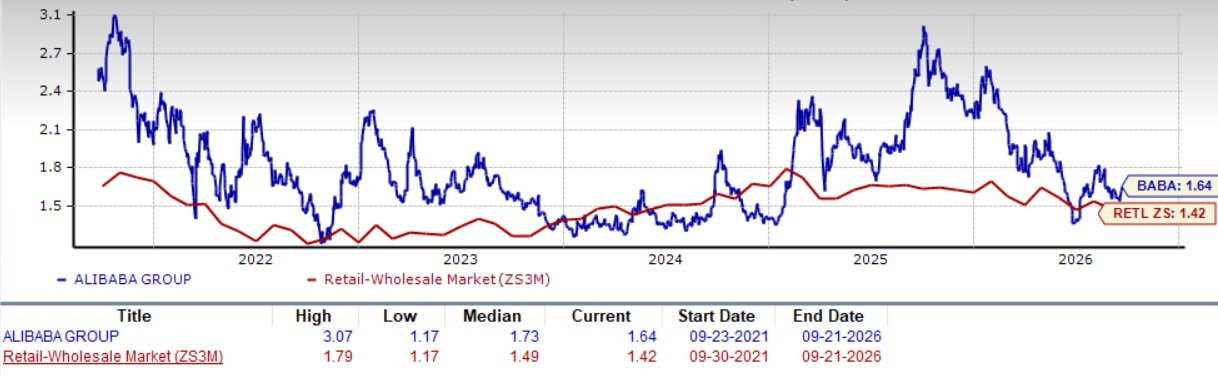
Image Source: Zacks Investment Research
Cloud and AI Commercialization Is Accelerating, Not Slowing
Alibaba’s cloud segment has moved from a promising growth story to a demonstrably accelerating one. External cloud revenue growth reached a multi-year high in the June quarter, with AI-related product revenues sustaining triple-digit year-over-year growth for 12 consecutive quarters and now representing more than a third of external cloud revenues. This is not incidental growth; it reflects deepening enterprise adoption of Alibaba’s Model-as-a-Service platform and proprietary chip stack. Holding through the current investment cycle allows shareholders to participate in this compounding monetization curve rather than stepping aside just as scale economics begin to show through in margins.
Core Commerce Remains a Cash Engine as Quick Commerce Grows
While quick commerce investment continues to weigh on near-term profitability, Alibaba’s e-commerce base is not deteriorating; it is being reorganized to capture new consumption patterns. Customer management revenue growth has held up on a like-for-like basis, and the newly consolidated e-commerce structure is designed to extract synergies across domestic and cross-border platforms rather than let them compete for the same resources. This underlying resilience in the core commerce engine gives the company the cash generation capacity to fund its AI ambitions without relying solely on external capital, a fundamental stabilizer that supports a hold rather than an exit.
Disciplined Long-Term Capital Allocation Toward AI Infrastructure
Elevated capital expenditure has compressed free cash flow and near-term earnings, but management has framed this spending within a defined multi-year AI infrastructure plan rather than open-ended outlays. The company has articulated a payback framework for AI-related capex based on current gross margins, with potential for that payback period to shorten as proprietary chip penetration increases and pricing power strengthens. This structured approach to reinvestment, rather than reactive spending, is a fundamental reason long-term holders can tolerate near-term margin pressure.
BABA’s Cloud, E-Commerce and AI Developments
Across its reporting segments, recent company disclosures point to broadening momentum. In cloud and AI, Alibaba used its September 2026 Apsara Conference to outline its next-generation Qwen roadmap, confirming that its upcoming Qwen 4 model is already in training, with future Qwen 4.5 and Qwen 5 versions projected to scale toward 5-10 trillion parameters. The event also introduced a new proprietary AI chip alongside an agentic cloud architecture and a mobile AI agent platform, reinforcing the company’s full-stack ambitions from chips to applications. In e-commerce, Alibaba has continued integrating Taobao Instant Commerce more tightly with its broader ecosystem, including its Qwen app, while its restructured China E-commerce Group works to unify Taobao, Tmall and international platforms such as AliExpress, Trendyol and Lazada under a shared consumption framework. On the AI applications front, the company released an updated open-weight image-generation model in September 2026, aimed at commercial design and e-commerce marketing use cases, extending its AI tools deeper into merchant workflows.
BABA’s Forward Guidance and Capital Spending
For its first-quarter fiscal 2027, Alibaba reported sharply higher capital expenditure year over year as it continues drawing down a previously announced three-year AI infrastructure investment plan, with a meaningful portion of that multi-year budget already deployed. Management guided that cloud revenue growth is expected to keep accelerating in coming quarters, with EBITDA margins expanding sequentially, and reiterated a longer-term ambition of a much larger external cloud revenue base with materially higher margins by decade’s end. Quick commerce losses are expected to keep narrowing, with a path to overall profitability targeted in the coming fiscal years, while its Model-as-a-Service annualized revenue run rate is targeted to roughly double by fiscal year-end.
The Zacks Consensus Estimate for fiscal 2027 earnings is pegged at $6.87 per share, implying 76.61% year-over-year growth, a key core reason holding through this pullback still carries fundamental merit.
Alibaba Group Holding Limited Price and Consensus

Alibaba Group Holding Limited price-consensus-chart | Alibaba Group Holding Limited Quote
BABA’s Share Price Performance and Competitive Landscape
BABA shares have plunged 18.6% year to date, underperforming the Zacks Internet – Commerce industry’s 3.4% growth and the Retail-Wholesale sector’s 1.4% decline, reflecting broad risk-off sentiment toward Chinese technology equities generally this year.
Competitively, Alibaba Cloud battles Amazon AMZN, Microsoft MSFT and Alphabet GOOGL-owned Google for enterprise AI workloads; Amazon’s AWS and Microsoft’s Azure still command greater global hyperscale share, while Google keeps expanding AI-native infrastructure, so pricing pressure stays elevated as Alibaba, Amazon, Microsoft and Google all pour heavy capital into compute capacity, and this scale gap is one reason to hold rather than chase shares higher right now.
BABA’s Year-to-date performance
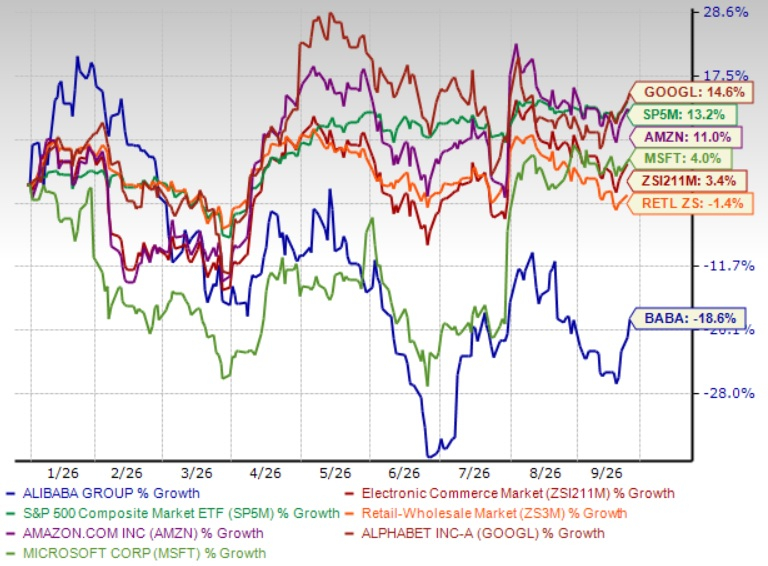
Image Source: Zacks Investment Research
Conclusion
Alibaba’s premium price-to-sales ratio reflects the market’s recognition of a business in the middle of a genuine transformation, not merely a legacy e-commerce operator carrying a rich multiple. The fundamental case for holding rests on accelerating cloud and AI monetization, a core commerce base stable enough to self-fund that transformation, and a capital allocation framework built around a defined payback horizon rather than unchecked spending. None of this eliminates near-term risk. Heavy capital expenditure will keep pressuring free cash flow, and quick commerce profitability will take meaningful time to fully materialize across the entire business. But for investors who already own the stock, these fundamental drivers are reasons to stay patient through the investment cycle rather than reasons to sell now.
New investors weighing a fresh entry may still prefer to wait for the current spending cycle to show a clearer margin payoff before committing, but existing shareholders have sufficient fundamental support to hold Alibaba stock through this phase rather than exit prematurely today. Alibaba currently carries a Zacks Rank #3 (Hold). You can see the complete list of today’s Zacks #1 Rank (Strong Buy) stocks here.
Radical New Technology Could Hand Investors Huge Gains
Quantum Computing is the next technological revolution, and it could be even more advanced than AI.
While some believed the technology was years away, it is already present and moving fast. Large hyperscalers, such as Microsoft, Google, Amazon, Oracle, and even Meta and Tesla, are scrambling to integrate quantum computing into their infrastructure.
Senior Stock Strategist Kevin Cook reveals 7 carefully selected stocks poised to dominate the quantum computing landscape in his report, Beyond AI: The Quantum Leap in Computing Power.
Kevin was among the early experts who recognized NVIDIA’s enormous potential back in 2016. Now, he has keyed in on what could be “the next big thing” in quantum computing supremacy. Today, you have a rare chance to position your portfolio at the forefront of this opportunity.
Alibaba Group Holding Limited (BABA) : Free Stock Analysis Report
Amazon.com, Inc. (AMZN) : Free Stock Analysis Report
Microsoft Corporation (MSFT) : Free Stock Analysis Report
Alphabet Inc. (GOOGL) : Free Stock Analysis Report
This article originally published on Zacks Investment Research (zacks.com).
5 Stocks Our Experts Predict Could Double In the Next Year
By submitting your email, you'll also get a free pivot & flow membership. A free daily market overview. You can unsubscribe at any time.