Key Points
-
Sirius XM Holdings faces ongoing competition from streaming giants and changing consumer habits.
-
Berkshire Hathaway has delivered decades of strong returns, outpacing many stocks — including Sirius XM.
-
With Warren Buffett’s retirement approaching, Berkshire Hathaway’s strong bench ensures continued success.
- 10 stocks we like better than Berkshire Hathaway ›
Once upon a time, satellite radio looked like a get-rich-quick scheme. The two predecessors of Sirius XM Holdings (NASDAQ: SIRI) made some people very rich in the second half of the 1990s, as new cars started shipping with satellite-enabled radios.
But Sirius XM’s stock peaked at the turn of the millennium, and longtime shareholders have seen share prices drop 97% from that ancient peak. A million dollars invested in Sirius XM on Feb. 17, 2000, would be worth roughly $32,000 on Oct. 10, 2025. With dividends reinvested along the way, you’d have a total return of $40,850 — still a disastrous result in 25 years and change.
Where to invest $1,000 right now? Our analyst team just revealed what they believe are the 10 best stocks to buy right now. Continue »
With a plethora of media-streaming options and nearly ubiquitous access to high-speed internet connections, Sirius XM looks like an unlikely winner these days. I would much rather invest in a proven performer that made more millionaires than Sirius XM ever did — and kept building their wealth for decades. In particular, I’m thinking about Warren Buffett’s Berkshire Hathaway (NYSE: BRK.A) (NYSE: BRK.B).
Image source: Getty Images.
Sirius XM Holdings is losing its signal
Just for fun, let’s imagine investing $32,000 in Sirius Satellite Radio and another $32,000 in Berkshire Hathaway’s Class B shares at the satellite radio veteran’s peak in February 2000. As expected, the Sirius XM bet would have dropped to approximately $1,000 by now. Berkshire investors, on the other hand, would have nearly half a million dollars in their portfolio:
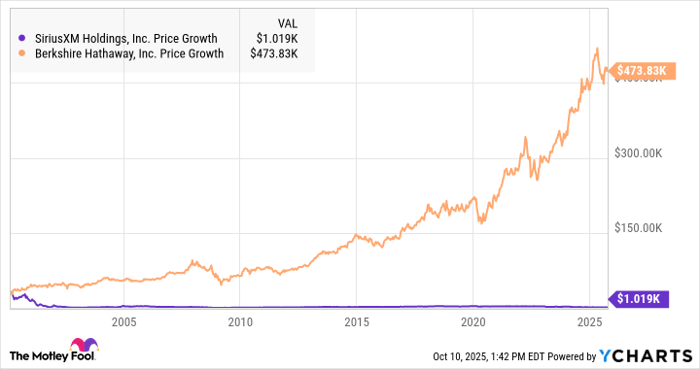
Yeah, I’m hand-picking the worst possible time to buy Sirius XM stock, but the picture doesn’t change much in other long-term spans. Berkshire’s robust insurance operations and brilliant equity investments have generated market-beating annual returns over the last few decades, no matter how you slice them.
Switching channels to Berkshire Hathaway’s proven success
Berkshire is like a mini-index or exchange-traded fund, all in one company. Its operations range from insurance (GEICO) and railroads (BNSF) to clothing (Fruit of the Loom) and batteries (Duracell). I’m sure you’re familiar with these household-name brands.
And that’s just the wholly owned businesses fully under Berkshire Hathaway’s control. Buffett’s company also owns large stock investments in many public companies, putting Berkshire representatives in their boardroom. The largest holdings include Apple (NASDAQ: AAPL) and American Express (NYSE: AXP), which add up to 39.5% of Berkshire’s stock portfolio right now.
If you insist on some Sirius XM exposure, Berkshire will serve that purpose too. It holds a dominant stake in the satellite radio business, at 37.1% of Sirius XM’s shares. Mind you, that’s still a small commitment for Berkshire at 0.9% of its diversified stock portfolio.
Berkshire Hathaway’s stellar stability
If you thought the S&P 500 (SNPINDEX: ^GSPC) was a calm, safe, and stable investment option, Berkshire Hathaway beats the market index in some ways.
-
The stock has a beta value of 0.7, which means that it tends to be significantly less volatile than the broader market.
-
For example, the S&P 500 fell 2.7% last Friday, along with identical price drops in index funds like the Vanguard S&P 500 ETF (NYSEMKT: VOO) and the SPDR S&P 500 ETF Trust (NYSEMKT: SPY). Buffett’s empire only fell 1.5% on the same tariff-escalation news.
-
Berkshire Hathaway’s stock tends to outperform the market in the long run, though it should be said that the index funds can make up the difference with dividend payouts. The total returns are very similar in multi-year periods:
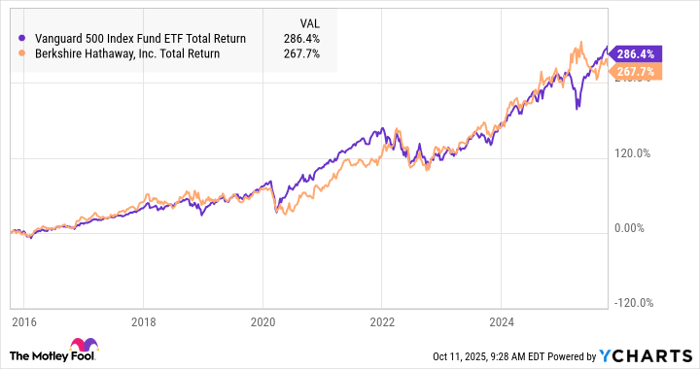
VOO Total Return Level data by YCharts
Berkshire Hathaway’s bench is as strong as its balance sheet
If there ever was a great time to start a Berkshire Hathaway investment, this might be it. Check out the total returns of the last 6 months:
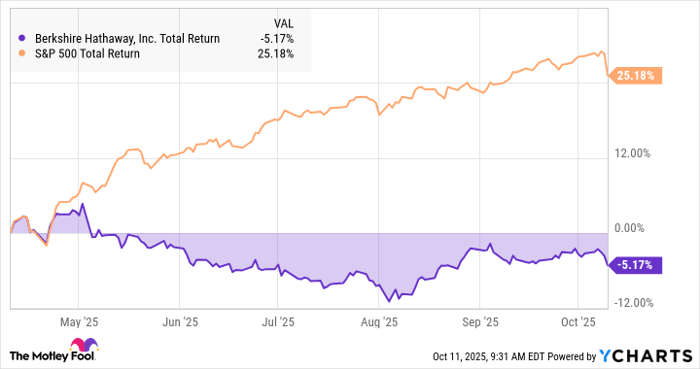
BRK.B Total Return Level data by YCharts
The tiny peak in early May was Berkshire Hathaway’s all-time high. It was also the last market day before Warren Buffett announced his retirement. The S&P 500 has soared since then while Berkshire investors missed the rally — the pending exit of a legendary leader weighs heavily on the stock.
But I have full confidence in incoming Berkshire Hathaway CEO Greg Abel and his fully intact team of executives, analysts, and portfolio managers. I can’t imagine a better investing mentor than Warren Buffett, and Abel has served by his side for decades. Abel and others have executed many of Berkshire’s investments in recent years, so it’s really just an upgraded title. Not much should change in terms of business operations.
And you can pick up Berkshire Hathaway shares at a discount while the market worries about this humble speed bump.
Berkshire has made lots of millionaires over the decades while Sirius XM’s wealth-building era was long ago and temporary. As with any rock-solid investment vehicle, adding money over time to a Berkshire Hathaway position could build a million-dollar portfolio for you, too.
Should you invest $1,000 in Berkshire Hathaway right now?
Before you buy stock in Berkshire Hathaway, consider this:
The Motley Fool Stock Advisor analyst team just identified what they believe are the 10 best stocks for investors to buy now… and Berkshire Hathaway wasn’t one of them. The 10 stocks that made the cut could produce monster returns in the coming years.
Consider when Netflix made this list on December 17, 2004… if you invested $1,000 at the time of our recommendation, you’d have $657,979!* Or when Nvidia made this list on April 15, 2005… if you invested $1,000 at the time of our recommendation, you’d have $1,122,746!*
Now, it’s worth noting Stock Advisor’s total average return is 1,060% — a market-crushing outperformance compared to 187% for the S&P 500. Don’t miss out on the latest top 10 list, available when you join Stock Advisor.
*Stock Advisor returns as of October 7, 2025
American Express is an advertising partner of Motley Fool Money. Anders Bylund has positions in Vanguard S&P 500 ETF. The Motley Fool has positions in and recommends Apple, Berkshire Hathaway, and Vanguard S&P 500 ETF. The Motley Fool has a disclosure policy.
5 Stocks Our Experts Predict Could Double In the Next Year
By submitting your email, you'll also get a free pivot & flow membership. A free daily market overview. You can unsubscribe at any time.