Key Points
Rivian (NASDAQ: RIVN) became one of the market’s hottest EV stocks after its 2021 IPO. Today, it trades 80% below its IPO price and more than 90% below its all-time high. Like many other smaller EV makers, Rivian lost its luster after missing its ambitious production targets and incurring steep losses. Rising interest rates also compressed its valuations.
But with a market cap of $18.8 billion, Rivian’s stock looks historically cheap at three times this year’s sales. Tesla (NASDAQ: TSLA) trades at 13 times this year’s sales. Therefore, any positive news could drive its stock higher. I believe the catalyst could be its second-quarter report on April 30 — so it could be smart to buy its stock before it posts those numbers.
Will AI create the world’s first trillionaire? Our team just released a report on the one little-known company, called an “Indispensable Monopoly” providing the critical technology Nvidia and Intel both need. Continue »
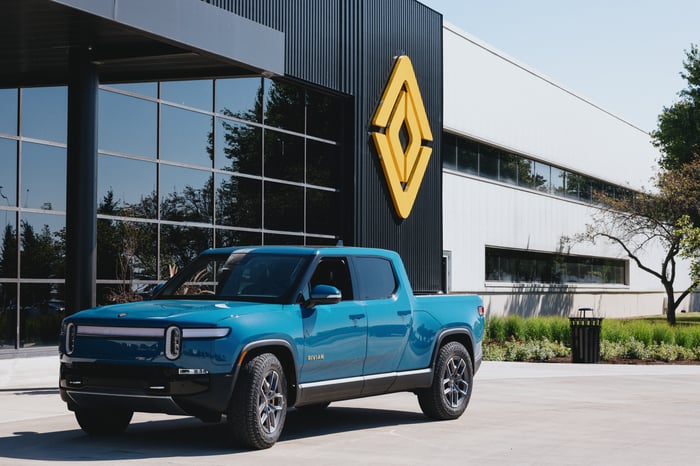
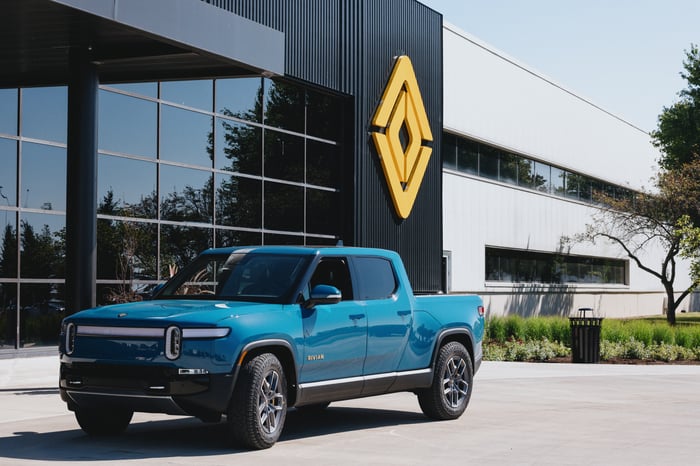
Image source: Rivian.
What happened to Rivian over the past few years?
Rivian originally produced three vehicles: the R1T pickup, R1S SUV, and electric delivery vans for Amazon and other companies. It launched its newest vehicle, the cheaper R2 SUV, this March. Here’s how many vehicles it produced over the past few years.
|
Year |
2022 |
2023 |
2024 |
2025 |
|---|---|---|---|---|
|
Vehicles Produced |
24,337 |
57,232 |
49,476 |
42,284 |
Data source: Rivian.
In 2024 and 2025, Rivian’s production declined amid supply chain constraints, reduced EV subsidies, and intense competition from Tesla and other EV makers. That slowdown drove away many of its top investors, including Ford Motor Company, and crushed its stock.
Why could Rivian’s stock bounce back?
Rivian’s slowdown was disappointing, but several catalysts could bring the bulls back. First, it expects the R2 — which costs $30,000-$40,000 less than the R1T and R1S — to significantly expand its reach and widen its moat against Tesla. Even though the R2 has a lower price tag, Rivian can sell it at higher margins than the R1T and R1S because it uses fewer electronic control units, an improved battery pack design, simpler wiring, and larger castings.
Therefore, if Rivian successfully ramps up its production and deliveries of its R2, it will stabilize its margins and narrow its losses. If Rivian reaffirms its 2026 delivery target of 62,000-67,000 vehicles on April 30 and confirms that the R2 is gaining momentum, its stock could rally.
Uber (NYSE: UBER) also recently invested $1.25 billion in Rivian and agreed to start deploying up to 10,000 fully autonomous R2 robotaxis from 2028 to 2031. Volkswagen (OTC:VWAP.Y) also recently completed winter tests of its vehicles using its co-developed software with Rivian, bringing Rivian closer to the next funding tranche for the deal. These catalysts could support Rivian’s growth as it gears up for the launch of its next vehicle, the higher-end R3 SUV, and expands its manufacturing capacity in Illinois and Georgia.
Rivian is still a speculative stock, but its insiders bought more than twice as many shares as they sold over the past three months. That warming insider sentiment, along with its low valuation and irons in the fire, makes it a good stock to buy ahead of its next earnings report.
Should you buy stock in Rivian Automotive right now?
Before you buy stock in Rivian Automotive, consider this:
The Motley Fool Stock Advisor analyst team just identified what they believe are the 10 best stocks for investors to buy now… and Rivian Automotive wasn’t one of them. The 10 stocks that made the cut could produce monster returns in the coming years.
Consider when Netflix made this list on December 17, 2004… if you invested $1,000 at the time of our recommendation, you’d have $536,003!* Or when Nvidia made this list on April 15, 2005… if you invested $1,000 at the time of our recommendation, you’d have $1,116,248!*
Now, it’s worth noting Stock Advisor’s total average return is 946% — a market-crushing outperformance compared to 190% for the S&P 500. Don’t miss the latest top 10 list, available with Stock Advisor, and join an investing community built by individual investors for individual investors.
*Stock Advisor returns as of April 9, 2026.
Leo Sun has positions in Amazon. The Motley Fool has positions in and recommends Amazon, Tesla, and Uber Technologies. The Motley Fool has a disclosure policy.
5 Stocks Our Experts Predict Could Double In the Next Year
By submitting your email, you'll also get a free pivot & flow membership. A free daily market overview. You can unsubscribe at any time.