Key Points
-
Nvidia currently generates higher overall revenue, maintaining a substantial and rapidly expanding absolute scale advantage over Advanced Micro Devices.
-
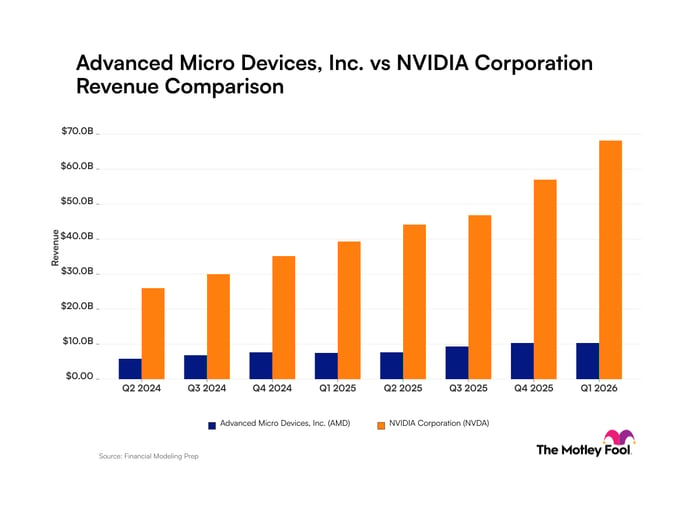
Nvidia has experienced consistent, rapid quarter-over-quarter revenue expansion, while Advanced Micro Devices has shown a much slower, relatively stable revenue trajectory over the same eight-quarter period.
-
Investors should carefully watch whether the widening revenue gap between the two companies continues to accelerate or begins to show signs of stabilizing in upcoming quarters.
- 10 stocks we like better than Advanced Micro Devices ›
Advanced Micro Devices: Steady Revenue Trajectory
Advanced Micro Devices (NASDAQ:AMD) primarily generates revenue by developing microprocessors, graphics processing units, and custom system-on-chip products for personal computers, servers, gaming consoles, and embedded systems worldwide.
It recently announced an investment of more than $10 billion to expand packaging capabilities in Taiwan alongside committing up to £2 billion for research in the United Kingdom. It reported 14% net income margin for the quarter ended March 28, 2026.
Nvidia: Rapid Revenue Expansion
Nvidia (NASDAQ:NVDA) earns most of its revenue by providing advanced graphics processors, networking hardware, and computational solutions used across personal computing, professional visualization, automotive platforms, and high-performance data centers.
While launching its Vera Rubin supercomputing platform and authorizing an additional $80 billion for share repurchases, it reported 72% net income margin for the quarter ended April 26, 2026.
Why Revenue Matters for Retail Investors
Revenue serves as a fundamental indicator of the total money a company brings in from its core operations before any expenses are deducted. This measurement gives retail investors insight into a company’s overall size, market footprint, and long-term trajectory.
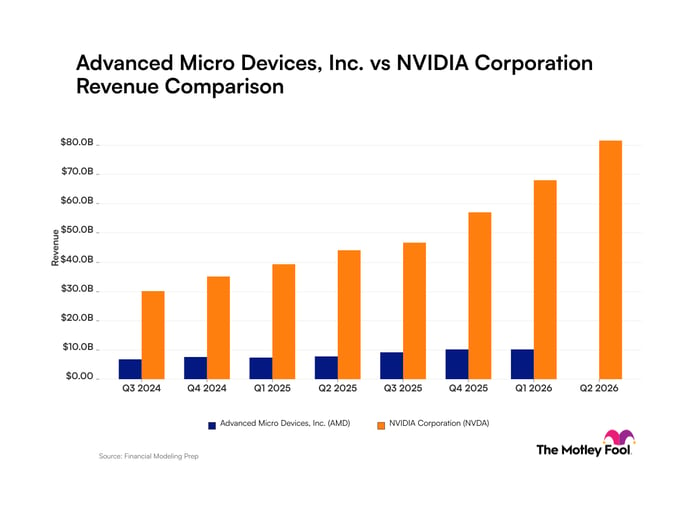
Quarterly Revenue for Advanced Micro Devices and Nvidia
| Quarter (Period End) | Advanced Micro Devices Revenue | Nvidia Revenue |
|---|---|---|
| Q3 2024 | $6.8 billion (period ended Sept. 2024) | $30.0 billion (period ended July 2024) |
| Q4 2024 | $7.7 billion (period ended Dec. 2024) | $35.1 billion (period ended Oct. 2024) |
| Q1 2025 | $7.4 billion (period ended March 2025) | $39.3 billion (period ended Jan. 2025) |
| Q2 2025 | $7.7 billion (period ended June 2025) | $44.1 billion (period ended April 2025) |
| Q3 2025 | $9.2 billion (period ended Sept. 2025) | $46.7 billion (period ended July 2025) |
| Q4 2025 | $10.3 billion (period ended Dec. 2025) | $57.0 billion (period ended Oct. 2025) |
| Q1 2026 | $10.3 billion (period ended March 2026) | $68.1 billion (period ended Jan. 2026) |
| Q2 2026 | Not yet reported | $81.6 billion (period ended April 2026) |
Data source: Company filings. Data as of July 7, 2026.
Foolish Take
The revenue gap between Nvidia and Advanced Micro Devices, and the former’s consistent quarter-over-quarter sales growth, illustrate Nvidia’s market dominance in high-performance semiconductor products, particularly for the artificial intelligence sector.
While AMD’s first-quarter sales of $10.3 billion represented excellent 38% year-over-year growth, it pales in comparison to Nvidia’s 85% year-over-year increase in its latest fiscal quarter, ended April 26. This significantly higher revenue growth rate underscores the robust demand Nvidia is experiencing for its AI solutions.
Despite what these revenue trends show, AMD’s stock has soared a jaw-dropping 273% over the past 12 months through July 9. Nvidia’s share price was up a mere 23% in that time.
The price-to-sales ratio between this pair of semiconductor giants points to the reason behind the share price disparity. Until its stock began to skyrocket, AMD’s P/S ratio at the end of Q1 was around 10 while Nvidia exceeded 20. This suggests AMD’s stock was a better value, leading to investors scooping up shares.
Moreover, Wall Street now has high expectations for Nvidia. Combined with investor concerns of the company’s dependence on AI spending to deliver outsized result, these factors make it progressively harder for the AI chip leader to achieve spectacular share price gains.
Should you buy stock in Advanced Micro Devices right now?
Before you buy stock in Advanced Micro Devices, consider this:
The Motley Fool Stock Advisor analyst team just identified what they believe are the 10 best stocks for investors to buy now… and Advanced Micro Devices wasn’t one of them. The 10 stocks that made the cut could produce monster returns in the coming years.
Consider when Netflix made this list on December 17, 2004… if you invested $1,000 at the time of our recommendation, you’d have $407,651!* Or when Nvidia made this list on April 15, 2005… if you invested $1,000 at the time of our recommendation, you’d have $1,252,823!*
Now, it’s worth noting Stock Advisor’s total average return is 922% — a market-crushing outperformance compared to 208% for the S&P 500. Don’t miss the latest top 10 list, available with Stock Advisor, and join an investing community built by individual investors for individual investors.
*Stock Advisor returns as of July 9, 2026.
Robert Izquierdo has positions in Advanced Micro Devices and Nvidia. The Motley Fool has positions in and recommends Advanced Micro Devices and Nvidia. The Motley Fool has a disclosure policy.
5 Stocks Our Experts Predict Could Double In the Next Year
By submitting your email, you'll also get a free pivot & flow membership. A free daily market overview. You can unsubscribe at any time.