Key Points
-
Tesla’s robotaxi rollout is delayed, but management remains optimistic about future scaling, even though it will take longer than previously anticipated.
-
A key milestone for the development of the robotaxi rollout will come with the release of the next major version of full self-driving software.
- These 10 stocks could mint the next wave of millionaires ›
Cathie Wood’s Ark Invest bought more than 160,000 shares in Tesla (NASDAQ: TSLA) after the recent results release and the following share price slump. The acquired shares are worth about $50.1 million at the time of writing. Is it a move worth following?
Why Ark Invest bought more stock
The move made logical sense for Ark. The company has long championed the bullish case for Tesla, and Tesla’s expected 2029 price is $2,600 per share. If Tesla continues to hold that opinion, and an underlying belief in the robotaxi rollout that drives its model (Ark assumes 88% of Tesla’s enterprise value in 2029 will come from robotaxi), then the dip is an opportunity to buy more.
Missed Nvidia in 2009? This Rare Signal Is Flashing Again. In 2009, a “Double Down” signal flashed for a little-known chipmaker called Nvidia. For the first time in years, that same “Total Conviction” signal is flashing for a company 1/100th the size of Nvidia. Continue »
Clearly, Ark isn’t put off by Tesla’s failure to meet the expectations CEO Elon Musk previously set for the robotaxi rollout.
Why Tesla’s robotaxi rollout isn’t meeting expectations
In April 2025, Musk predicted there would be “millions of Teslas operating autonomously” in the second half of 2026. In July 2025, he told investors Tesla would “probably” have autonomous ride-hailing covering half the U.S. population by the end of 2025. In October 2025, he promised robotaxis in “about 8 to 10 metro areas by the end of the year.” In January, Musk said the robotaxi fleet “will probably double every month, type of thing.”
These aims weren’t met.
Expectations matter
This matters for three reasons. First, investors do buy stocks and pencil in valuation scenarios based on management’s pronouncements.
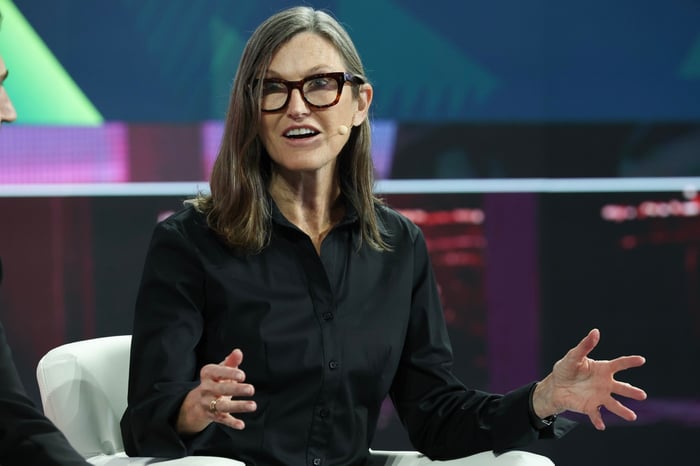
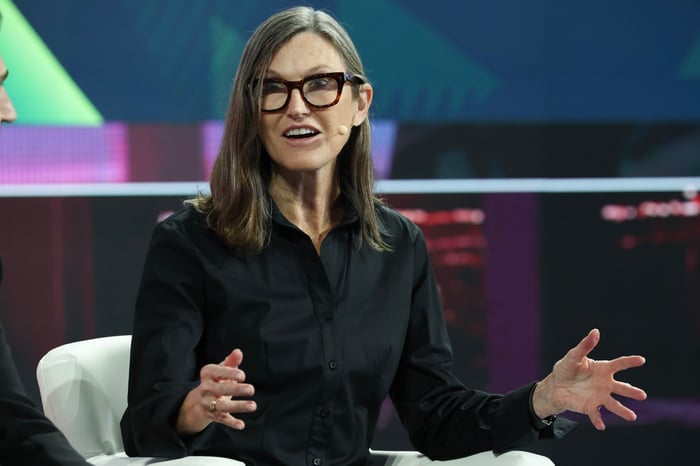
Ark Invest CEO Cathie Wood. Image source: Getty Images.
Second, Tesla’s internal plans, including capital spending ramps, are presumably based on these assumptions. Third, every time expectations for robotaxi expansion and, ultimately, cash flow from ride-share revenue are pushed back, investors and analysts should lower valuation expectations, as cash flow later has lower value than cash flow upfront.
What Tesla said about the robotaxi rollout
Management began articulating a more cautious take on the rollout in April, with Musk outlining that Tesla would make architectural improvements to safety before implementing robotaxi on a “large scale.” This implies the validation and release of the next major version of full self-driving (FSD) software, v15. Given that Musk doesn’t expect that to happen before the end of the year or early 2027, it should have been clear that a massive robotaxi scaling won’t occur until 2027 at the earliest.
Unfortunately, that reality didn’t appear to hit home with many investors at the time. On the recentearnings call management’s comments made it clear that achieving safety and reliability came first. CFO Vaibhav Taneja said: “There are things not just on the software front, on the operation front, which we’re also trying to tackle,” so it’s not just about v15 FSD. Musk noted that achieving an ultra-high level of reliability is “the only thing really constraining our growth in robotaxi.”
Is Tesla stock a buy?
Ark probably took heart from Tesla’s head of AI, Ashok Elluswamy, who said that Tesla’s robotaxis are already running on early versions of v15, and that 40% of the seven major improvement tracks planned for v15 are currently working together. Moreover, the number of unsupervised miles driven is growing at a double-digit rate, even if the fleet and location expansion aren’t.
These are very positive developments that are being ignored by a market that’s finally realized there will be no massive robotaxi rollout in 2026. The latter won’t disappoint Ark too much, as there’s a huge margin of safety for a delayed rollout between the current price of $313 and its expected value of $2,600 in 2029.
Ultimately, if you share Ark’s enthusiasm, the stock is a buy. However, anyone buying it needs to be aware that until Tesla releases v15 and starts exponential scaling in fleet and miles, question marks will hang over it.
Don’t miss this second chance at a potentially lucrative opportunity
Ever feel like you missed the boat in buying the most successful stocks? Then you’ll want to hear this.
On rare occasions, our expert team of analysts issues a “Double Down” stock recommendation for companies that they think are about to pop. If you’re worried you’ve already missed your chance to invest, now is the best time to buy before it’s too late. And the numbers speak for themselves:
- Nvidia: if you invested $1,000 when we doubled down in 2009, you’d have $510,315!*
- Apple: if you invested $1,000 when we doubled down in 2008, you’d have $64,213!*
- Netflix: if you invested $1,000 when we doubled down in 2004, you’d have $379,662!*
Right now, we’re issuing “Double Down” alerts for three incredible companies, available when you join Stock Advisor, and there may not be another chance like this anytime soon.
*Stock Advisor returns as of July 28, 2026.
Lee Samaha has no position in any of the stocks mentioned. The Motley Fool has positions in and recommends Tesla. The Motley Fool has a disclosure policy.
5 Stocks Our Experts Predict Could Double In the Next Year
By submitting your email, you'll also get a free pivot & flow membership. A free daily market overview. You can unsubscribe at any time.