Oracle Corporation ORCL and Alibaba Group BABA sit at opposite ends of the globe but occupy strikingly similar ground in today’s technology race. Both transformed from legacy roots, enterprise software for Oracle and e-commerce for Alibaba, into full-stack cloud and AI powerhouses, pouring billions into data centers, custom silicon, and language models.
The comparison feels especially timely now. Oracle just closed fiscal 2026 with record cloud growth and an unprecedented order backlog, while Alibaba wrapped its fiscal year with accelerating cloud and AI revenues even as profitability absorbed the cost of aggressive spending. Both companies have used recent weeks to unveil fresh AI models, chips and partnerships, underscoring how central this race is to their strategies.
Let’s delve deep and closely compare the fundamentals of the two stocks to determine which one is a better investment now.
The Case for ORCL Stock
Oracle delivered a standout fiscal 2026, with total revenues climbing 17% to a record $67.4 billion and cloud revenues surging 39% to $34 billion. The real headline, though, is Remaining Performance Obligations, which ended the year at $638 billion, up 363% year over year and $85 billion sequentially, reflecting a wave of large-scale AI contracts. Encouragingly, prepaid and customer-supplied hardware within these contracts now totals $75 billion, meaningfully easing the capital Oracle itself must raise to build out AI data centers. Momentum has carried into the new fiscal year.
At Google Cloud Next 2026, Oracle deepened its partnership with Google, integrating Gemini Enterprise directly with Oracle AI Database so customers can reason over business data without duplication. Oracle also expanded its NVIDIA collaboration for scalable AI supercomputing, launched an AI-native builder experience for Fusion Applications letting developers create agentic apps using familiar tools, expanded its Defense Ecosystem, and became a founding partner of IMSA Labs, applying racetrack telemetry to harden its Cloud Infrastructure. OCI continues broadening its AI stack too, adding models like GLM 5.2 and expanding governance and security controls for enterprise customers.
Management also flagged that a new AI-driven patient care management system should push Oracle Health’s overall growth to double digits in fiscal 2027, and the company also plans to raise an additional $20 billion in equity and debt to keep pace with demand. With profit guidance raised alongside steady revenue guidance, Oracle’s expanding backlog, capital-efficient contract structure and widening enterprise AI footprint make a compelling growth case.
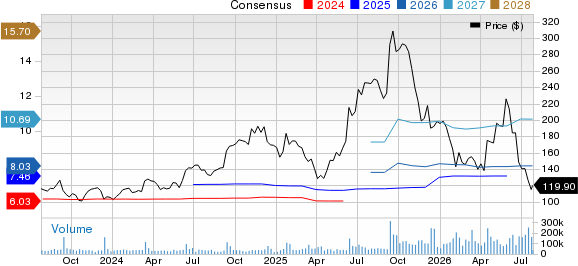
The Zacks Consensus Estimate for ORCL’s fiscal 2027 earnings is pegged at $8.03, which suggests 5.24% growth over the figure reported in fiscal 2026.
Oracle Corporation Price and Consensus

Oracle Corporation price-consensus-chart | Oracle Corporation Quote
The Case for BABA Stock
Alibaba’s fiscal 2026 close showed genuine cloud and AI momentum alongside real financial strain. Cloud Intelligence Group external revenue growth accelerated to 40%, with AI-related products now representing 30% of that revenue, and international commerce wholesale revenues also rose 9% on stronger cross-border value-added services.
Alibaba has kept pace on models, unveiling Qwen3.7-Max in May and previewing the 2.4-trillion-parameter, fully multimodal Qwen3.8 at the World AI Conference in July, now accessible to developers through its Qoder coding platform, while its Zhenwu chips now power more than 100,000 deployments across over 30 automakers and autonomous-driving companies building intelligent-driving systems. The company also launched Accio Work, extending its established AI sourcing agent, Accio, into a fuller agentic platform covering the entire operating lifecycle of small cross-border businesses. Management struck a bullish long-term tone, expecting AI-related annualized recurring revenues to reach RMB30 billion by year-end and signaling that capital expenditure will likely overshoot its original three-year RMB380 billion target, since compute demand is expected to be tenfold 2022 levels within the coming years.
That conviction, however, comes with visible near-term costs. Overall revenues grew just 3% year over year, while adjusted EBITA and net income both fell sharply as spending on AI, cloud infrastructure and instant commerce competition intensified. Alibaba did approve an annual dividend of $1.05 per ADS for fiscal 2026, a modest shareholder-friendly offset. The overall setup still leaves Alibaba with credible AI upside tempered by real near-term margin pressure and a still-escalating, open-ended investment cycle whose payoff timeline remains uncertain.
The Zacks Consensus Estimate for fiscal 2027 earnings is pegged at $6.88 per share, down 5.2% over the past 30 days, indicating a 76.86% year-over-year increase.
Alibaba Group Holding Limited Price and Consensus

Alibaba Group Holding Limited price-consensus-chart | Alibaba Group Holding Limited Quote
Valuation and Price Performance
On valuation, Oracle trades at a discounted forward 12-month price-to-earnings ratio of 14.18x, while Alibaba commands a premium 14.85x multiple, suggesting the market is pricing in more optimism for Alibaba’s AI-driven turnaround relative to Oracle’s heavier near-term spending burden.
ORCL vs. BABA P/E Ratio
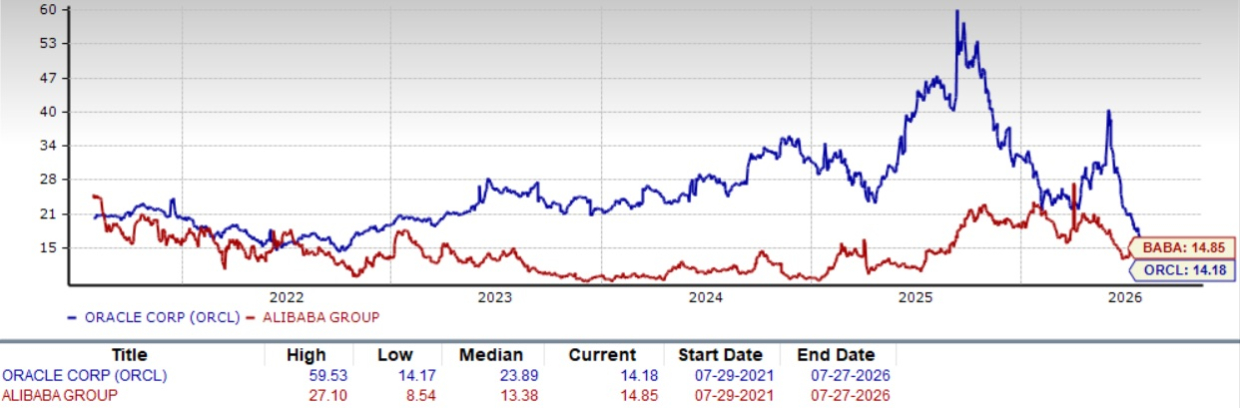
Image Source: Zacks Investment Research
Price action, however, tells a very different story: Oracle shares have plunged 38.5% year to date, underperforming Alibaba’s 21.5% gain over the same period. That divergence has left Oracle trading cheaper despite stronger backlog visibility and raised guidance, while Alibaba’s rally has already priced in much of its recent AI momentum, model launches and chip progress, leaving comparatively less room for further re-rating.
ORCL Underperforms BABA Year to Date
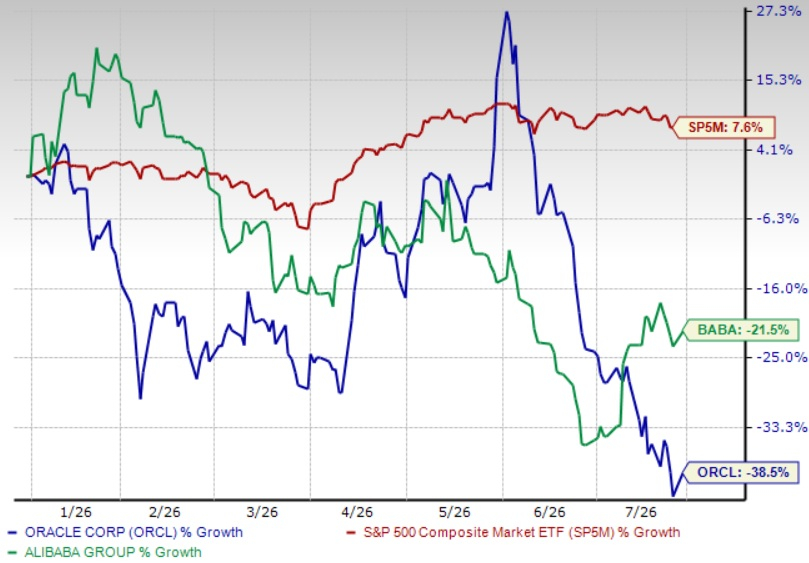
Image Source: Zacks Investment Research
Conclusion
Oracle’s record RPO backlog, capital-efficient AI contracts, raised profit guidance, widening Google and NVIDIA partnerships, and discounted valuation after a sharp pullback together give it a clear fundamental edge over Alibaba, whose AI and cloud progress is genuine but still weighs on near-term profitability amid an open-ended, escalating capex cycle and intensifying domestic competition. That combination of visibility, cheaper valuation and a funded AI buildout leaves Oracle better positioned to reward patient investors from current levels. Investors may therefore consider buying Oracle stock here, while holding Alibaba positions or waiting for a more attractive entry point before adding fresh exposure. ORCL currently carries a Zacks Rank # 2 (Buy), whereas BABA has a Zacks Rank #3 (Hold). You can see the complete list of today’s Zacks #1 Rank (Strong Buy) stocks here.
Beyond Nvidia: AI’s Second Wave Is Here
The AI revolution has already minted millionaires. But the stocks everyone knows about aren’t likely to keep delivering the biggest profits. AI’s second wave is moving from infrastructure to implementation and these companies are at the forefront of this transition, positioned to become what Amazon and Google were to the internet era.
Oracle Corporation (ORCL) : Free Stock Analysis Report
Alibaba Group Holding Limited (BABA) : Free Stock Analysis Report
This article originally published on Zacks Investment Research (zacks.com).
5 Stocks Our Experts Predict Could Double In the Next Year
By submitting your email, you'll also get a free pivot & flow membership. A free daily market overview. You can unsubscribe at any time.