Key Points
-
Many Tesla bulls have high conviction about the company’s AI infrastructure efforts, Optimus and Robotaxi.
-
For now, Optimus has yet to be deployed commercially, while Robotaxi’s growth has been uninspiring.
-
Druckenmiller’s options may still prove profitable, as many investors are likely overlooking a key performance metric.
- These 10 stocks could mint the next wave of millionaires ›
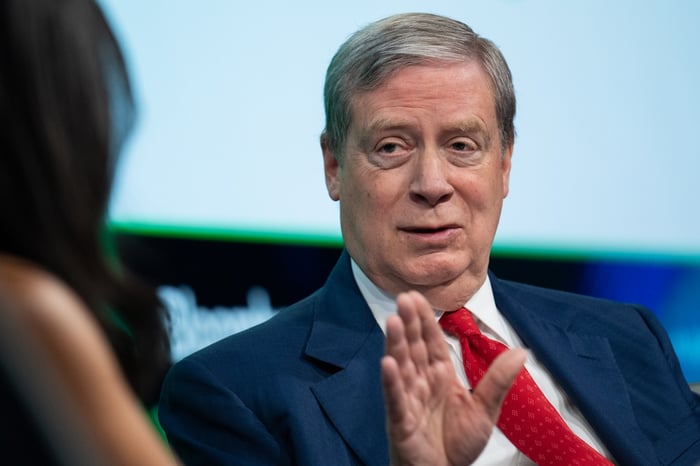
As a macro trader whose career has featured numerous bold moves, Stanley Druckenmiller is one of the most respected figures in modern investing. As the former portfolio manager of George Soros’s Quantum Fund, he helped orchestrate the 1992 short of the British pound — a trade that generated a cool billion-dollar profit.
He later turned Duquesne Capital into an investing machine that delivered average annual returns near 30% with no down years before closing the fund in 2010 and shifting his priorities to his own family office. Investors pay close attention to Druckenmiller because of his uncanny pattern-recognition skills that have repeatedly identified inflection points ahead of the crowd.
Missed Nvidia in 2009? This Rare Signal Is Flashing Again. In 2009, a “Double Down” signal flashed for a little-known chipmaker called Nvidia. For the first time in years, that same “Total Conviction” signal is flashing for a company 1/100th the size of Nvidia. Continue »
Stanley Druckenmiller. Image source: Getty Images.
This makes his recent purchase of Tesla (NASDAQ: TSLA) call options — a bet on a rising share price — particularly interesting. Even as the stock plummets more than 20% so far this year and continues to trade at valuations that would make most traditional investors run for the hills, I can’t help but think Druckenmiller sees something in Tesla that others are missing at the moment.
Image source: The Motley Fool.
Analyzing Tesla’s valuation and the narrative behind it
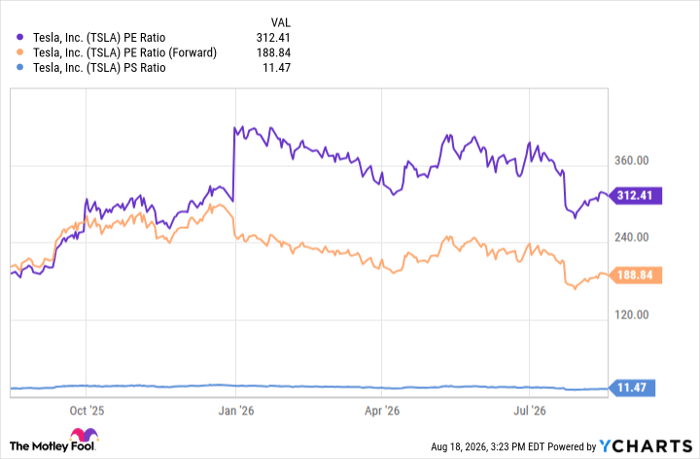
Tesla commands a market capitalization of almost $1.4 trillion. This translates into a trailing price-to-earnings (P/E) ratio of more than 300, while its forward-earnings multiple remains elevated in the 190 range. Tesla’s price-to-sales (P/S) sits near 11.
TSLA PE Ratio data by YCharts.
By comparison, established auto manufacturers like General Motors and Ford trade at single-digit forward-earnings multiples and P/S ratios of less than 1. Even pure play electric-vehicle (EV) peers like BYD sport more modest valuation multiples, typically less than 20 times forward earnings and about one times sales.
Tesla’s valuation premium exists entirely because investors are assigning substantial value to two nascent artificial intelligence (AI) ambitions: the Optimus humanoid robot and the Robotaxi driving network. In effect, investors are currently paying for the possibility that these efforts will generate substantial profits and network effects far beyond the economics of selling cars.
Where do Optimus and Robotaxi currently stand?
Optimus remains firmly in the prototype phase. Although factory lines at Tesla’s Fremont, California, facility are being installed after the decommissioning of older EV model production, build-outs for training data collection are still limited. For now, the robot is not a commercial product generating revenue.
Meanwhile, Robotaxi has finally moved beyond demonstration but has yet to deliver the disruptive scale Elon Musk long promised. According to Tesla’s second-quarter earnings report, cumulative paid miles for Robotaxi climbed past 2.4 million. However, smart investors discovered that the pace of Robotaxi’s growth actually flattened in recent months.
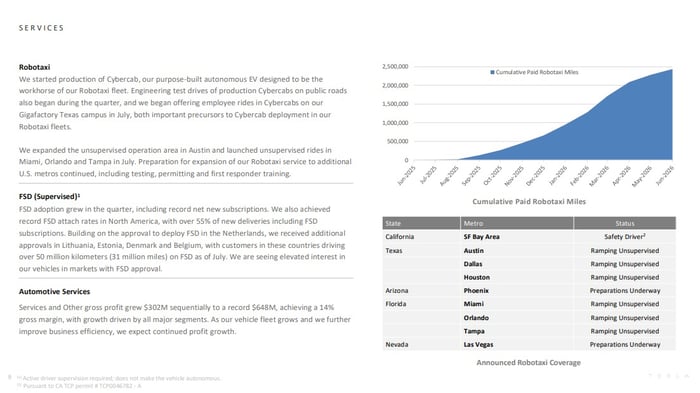
Image source: Tesla Investor Relations.
Quarterly additions stalled near 900,000 miles — slipping even as the Robotaxi service expanded into additional metropolitan areas. Moreover, much of the active fleet still operates with safety monitors in the cars. What Musk once characterized as an imminent fleet of a million autonomous vehicles looks more like a carefully controlled pilot whose adoption has not accelerated with the optimistic rhetoric.
Why Druckenmiller’s Tesla position could still pay off
Despite Tesla’s frothy valuation and the shortfalls of Robotaxi so far, Druckenmiller’s decision to buy call options might still be defensible. I should note that his 13F filings do not specify which option chain Druckenmiller specifically bought. This means that his calls could be short-dated or stretch well into the future. Either way, I think the position will be profitable.
My reasoning revolves around growth from Tesla’s autonomous driving software. My suspicion is that Druckenmiller is ignoring any noise around Robotaxi and is counting more heavily on the scale and margin potential of Tesla’s full self-driving (FSD) platform.
During Q2, active FSD users reached 1.48 million — a 56% increase year over year. More than 55% of new deliveries in North America now include the FSD feature, which requires a subscription. This is important because the recurring revenue nature of FSD translates into software-like margins for Tesla, helping offset capital-intensive initiatives like Optimus and Robotaxi.
More importantly, the expanding base of FSD users feeds Tesla’s proprietary data library. This helps the company accumulate real-world driving miles at a scale no competitor has yet to match, positioning Tesla as a potential first-mover with a durable competitive advantage in autonomous driving.
While I suspect Tesla stock will remain volatile for the time being, smart investors are looking beyond the company’s AI vision and focusing more clearly on its established product lines. With FSD subscriptions fueling Services revenue, I think more investors will come to realize Tesla is quietly evolving beyond an EV manufacturer and finally — albeit slowly — becoming the tech-enabled platform long promised by Musk.
Don’t miss this second chance at a potentially lucrative opportunity
Ever feel like you missed the boat in buying the most successful stocks? Then you’ll want to hear this.
On rare occasions, our expert team of analysts issues a “Double Down” stock recommendation for companies that they think are about to pop. If you’re worried you’ve already missed your chance to invest, now is the best time to buy before it’s too late. And the numbers speak for themselves:
- Nvidia: if you invested $1,000 when we doubled down in 2009, you’d have $564,979!*
- Apple: if you invested $1,000 when we doubled down in 2008, you’d have $60,438!*
- Netflix: if you invested $1,000 when we doubled down in 2004, you’d have $432,621!*
Right now, we’re issuing “Double Down” alerts for three incredible companies, available when you join Stock Advisor, and there may not be another chance like this anytime soon.
*Stock Advisor returns as of August 21, 2026.
Adam Spatacco has positions in Tesla. The Motley Fool has positions in and recommends Tesla. The Motley Fool recommends BYD Company and General Motors. The Motley Fool has a disclosure policy.
5 Stocks Our Experts Predict Could Double In the Next Year
By submitting your email, you'll also get a free pivot & flow membership. A free daily market overview. You can unsubscribe at any time.