Key Points
-
Stocks tied to the artificial intelligence build-out fell Monday after leaders at Anthropic and OpenAI called for the industry to slow down.
-
Netflix put $9.9 billion of cash into content in the first half of 2026 — and just $415 million into property and equipment.
-
Netflix expects to generate about $12.5 billion of free cash flow in 2026.
- 10 stocks we like better than Netflix ›
Stocks tied to the artificial intelligence (AI) build-out sold off Monday morning. The selling followed a weekend essay from Anthropic CEO Dario Amodei calling for the industry to slow the pace at which it develops more capable AI models — an idea that OpenAI CEO Sam Altman backed.
Memory specialist Micron Technology fell about 5%, chip designer Arm Holdings dropped about 9%, and Nvidia slid about 3%.
Missed Nvidia in 2009? This Rare Signal Is Flashing Again. In 2009, a “Double Down” signal flashed for a little-known chipmaker called Nvidia. For the first time in years, that same “Total Conviction” signal is flashing for a company 1/100th the size of Nvidia. Continue »
Netflix (NASDAQ:NFLX) went the other direction. Shares of the streaming giant rose about 4% Monday morning to about $80 as of this writing.
Some of the credit likely goes to Evercore ISI, which raised its price target on the stock to $110 from $100 before the market opened.
Still, the split makes sense to me. When investors get nervous about the price tag on the AI build-out, money can rotate toward growth stories that don’t depend on it. And Netflix’s cash-flow statement shows just how well the company fits that description.

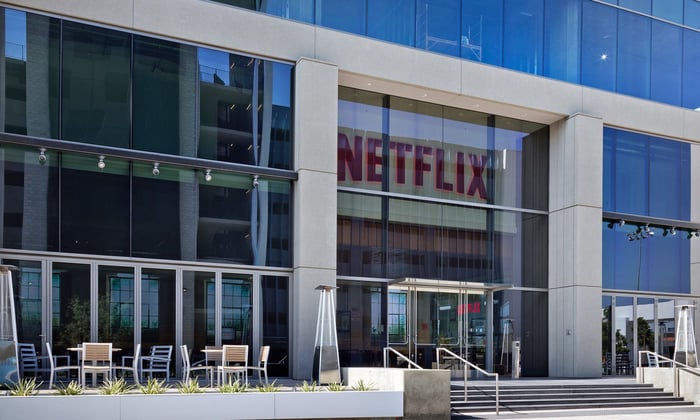
Image source: Netflix.
Netflix's biggest bill is programming
Netflix put $9.9 billion of cash into content during the first six months of 2026, up 24% year over year. Its purchases of property and equipment (the offices, buildings, and equipment that count as capital expenditures) totaled $415 million over those same six months. In other words, for every dollar the company spent on hard assets, it spent more than $23 on series, films, and live events. At its first-half pace, this year's content spending would approach $20 billion.
Twenty billion dollars is a lot of content until you set it next to the companies building AI data centers. Alphabet (NASDAQ:GOOG) (NASDAQ:GOOGL) put $44.9 billion into property and equipment in the second quarter alone, roughly double what it spent a year earlier. The Google parent now plans between $195 billion and $205 billion of capital expenditures for 2026, and coming into the year, the four biggest builders of AI data centers were planning close to $700 billion of combined capital spending.
Zoom out, and Alphabet's single quarter of capital spending was more than double what Netflix will likely spend on content in all of 2026. And Netflix's entire base of property and equipment sits at just $2.4 billion on its balance sheet -- less than a week's worth of Alphabet's current pace of capital spending.
Billions left over
Nearly $10 billion of programming in six months is still an enormous outlay. Netflix's operations, however, already generate enough cash to cover every dollar of it, with billions to spare. Free cash flow (what's left of operating cash flow after purchases of property and equipment) totaled $6.6 billion in the first half of the year, up 34% year over year. Management continues to expect about $12.5 billion for the full year, which would be up more than 30% from 2025 -- though that growth gets a one-time lift from the $2.8 billion termination fee Netflix collected when the Warner Bros. deal fell through.
Revenue, for perspective, is forecast to grow 13% to 14% this year. The cash is growing about twice as fast as revenue.
Not only did Netflix buy back $4.7 billion of its stock in the second quarter (its largest quarter of repurchases yet), but it also has about $27 billion left on its repurchase authorizations.
Of course, the biggest AI spenders are headed the opposite direction. Reaching this year's capital budgets is expected to mean a sharp drop in the group's free cash flow, and the payoff on those data centers may be years away. A slower build-out would actually ease that cash strain, which may be why Monday's selling hit the companies that sell the hardware hardest.
Why is the stock still down 36%?
The stock would need to climb more than 50% to get back to its 52-week high of about $125. And the reason it fell that far hasn't gone anywhere.
Second-quarter revenue grew 13% year over year, a step down from 16% in the first quarter, and management expects about 12% for the third quarter. That pace has cooled every quarter this year, and it could slip a little more from here.
Also worth noting: Netflix isn't avoiding AI on principle. The company says it's using the technology to personalize its service and help produce its films and series. A slower AI industry wouldn't help Netflix -- it just wouldn't cost it much, either.
At about 21 times next year's expected earnings, the stock looks fairly priced to me if growth levels off. But if growth keeps slowing, it won't be.
Ultimately, Monday's sell-off was about whose business depends on the AI build-out continuing at full speed, and Netflix's doesn't.
The bigger issue for the stock is still its slowing growth. One good Monday doesn't settle that.
Should you buy stock in Netflix right now?
Before you buy stock in Netflix, consider this:
The Motley Fool Stock Advisor analyst team just identified what they believe are the 10 best stocks for investors to buy now… and Netflix wasn’t one of them. The 10 stocks that made the cut could produce monster returns in the coming years.
Consider when Netflix made this list on December 17, 2004... if you invested $1,000 at the time of our recommendation, you’d have $417,413!* Or when Nvidia made this list on April 15, 2005... if you invested $1,000 at the time of our recommendation, you’d have $1,341,294!*
Now, it’s worth noting Stock Advisor’s total average return is 950% — a market-crushing outperformance compared to 212% for the S&P 500. Don't miss the latest top 10 list, available with Stock Advisor, and join an investing community built by individual investors for individual investors.
*Stock Advisor returns as of September 14, 2026.
Daniel Sparks and his clients do not have positions in any of the stocks mentioned. The Motley Fool has positions in and recommends Alphabet, Arm Holdings, Micron Technology, Netflix, and Nvidia. The Motley Fool has a disclosure policy.
5 Stocks Our Experts Predict Could Double In the Next Year
By submitting your email, you'll also get a free pivot & flow membership. A free daily market overview. You can unsubscribe at any time.