
The whipping post

Rivian’s Nosedive: Decrypting the 19% Plummet in April Rivian’s Nosedive: Decrypting the 19% Plummet in April

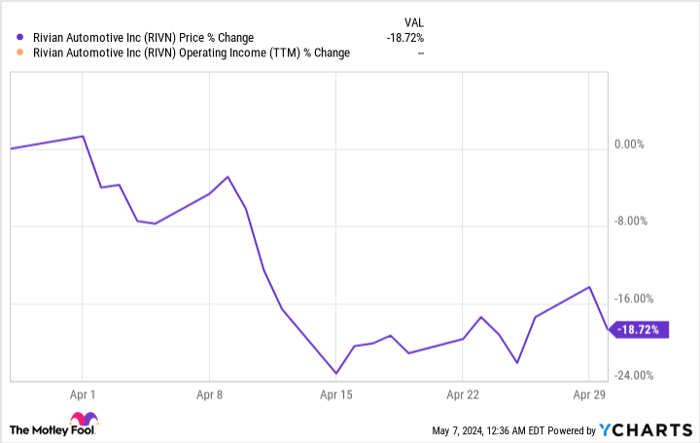
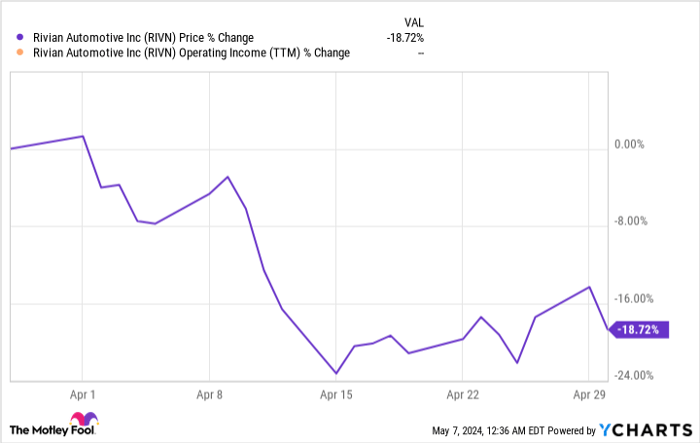
Shares of Rivian, the electric-vehicle (EV) maker traded under NASDAQ: RIVN, faced a tumultuous April, diving 19% amidst relentless pressure mounting on the EV sector.

The downward spiral was triggered by a confluence of events – competitors slashing prices, dwindling hopes of a Federal Reserve rate cut, and lackluster deliveries and financial performance by industry juggernaut Tesla.

According to S&P Global Market Intelligence, Rivian’s stock closed the month with a 19% decrease, predominantly occurring in the initial half of April.
RIVN Chart

RIVN data by YCharts

Rivian’s Downhill Journey

April kicked off on a sour note for Rivian after the company’s delivery numbers matched expectations while reiterating its guidance to produce 57,000 vehicles for the year.

Rivian disclosed delivering 13,588 vehicles in the first quarter, leaving investors yearning for an upward revision in the guidance.

Simultaneously, Tesla’s report reflected a 9% slump in first-quarter earnings, exposing vulnerabilities in the broader EV landscape.

The second week of April proved to be the toughest for Rivian, compounded by Ford Motor slashing prices for the F-150 Lightning EV, intensifying the pricing rivalry between Rivian and Ford, two prominent EV pickup manufacturers.

Furthermore, the March Consumer Price Index release on April 10 exhibited a resurgence in inflation, dashing hopes of a Fed interest rate reduction later in the year. High interest rates suppress demand for pricey vehicles, whereas a rate cut was anticipated to alleviate luxury carmakers like Rivian.

On April 17, Rivian disclosed a 1% workforce reduction, a concrete step towards curbing its substantial losses.

A Rivian pickup truck in the desert.

Image source: Rivian.

Future Trajectory for Rivian

Investors await a significant update from Rivian post-market on Tuesday through its comprehensive first-quarter earnings report.

See also  Riding the Wave: Stocks Poised to Surge Under a Kamala Harris Presidency Opportunities in Renewable Energy

If Democratic Party presidential nominee Kamala Harris clinches the victory in November, the stock market could witness significant shifts, with certain stocks positioned to capitalize on the potential changes. While the political sphere and Wall Street often dance to different tunes, the policies shaped by the incoming administration can sway the fortunes of corporations and subsequently impact the stock market milieu.

Image source: Official White House Photo by Lawrence Jackson.

Vice president and presidential hopeful Kamala Harris has put forth an array of proposals, inclusive of plans for expanded construction of starter homes, decreased food and drug expenses, and enhanced tax credits for middle-class families. Additionally, her proposition to raise the corporate tax rate by 33% could have repercussions that extend from Wall Street to Main Street.

While some companies may face challenges under Harris's proposed policies, there exist certain stocks that stand to gain considerably in the event of her victory. Here are three stocks that could see a surge if Kamala Harris emerges victorious in the upcoming election.

NextEra Energy: Leading the Charge

NextEra Energy, the nation's largest electric utility by market value, emerges as a formidable contender poised to soar should Kamala Harris secure the presidency. The company's unwavering focus on renewable energy sources sets it apart from its peers, with almost half of its 72 gigawatts of operational capacity attributed to renewables, specifically solar and wind power.

Despite the recent uptick in interest rates, NextEra Energy continues to forge ahead with clean-energy investments, committing billions of dollars to infrastructure projects. The company anticipates a substantial increase in new renewables and storage capacity, positioning itself as a frontrunner in the realm of clean energy.

NextEra Energy's proactive investments have not only driven down electricity generation costs but have also solidified its standing as a growth stock in an industry synonymous with sluggish growth trends.

Image source: Getty Images.

NVR: A Beacon in Homebuilding

If Kamala Harris's plan to oversee the construction of 3 million new homes materializes, it could spell good news for NVR, a company known for its focus on affordable, entry-level homes. NVR, particularly through its subsidiary Ryan Homes, stands to benefit from tax incentives for homebuilders catering to first-time buyers, as well as increased funding to incentivize local governments to ease zoning restrictions.

NVR's asset-light strategy, relying on lot purchase agreements instead of heavy capital investments in land acquisition, has been central to its remarkable success. By eschewing substantial capital outlays, NVR has outpaced larger competitors, boasting an impressive 23% annualized earnings growth rate over the past five years.

In addition, NVR's mortgage banking segment is primed to reap the rewards of a dovish Federal Reserve, aligning well with Harris's focus on addressing the housing shortage. The convergence of these factors paints a rosy picture for NVR and its stakeholders moving forward.

Mobileye Global: Driving Innovation

In the realm of autonomous driving technology, Mobileye Global is poised to make significant strides should Kamala Harris secure the presidency. With an emphasis on advancing road safety through cutting-edge solutions, Mobileye Global's innovative endeavors align closely with Harris's vision for a sustainable future.

As the landscape of transportation undergoes rapid evolution, Mobileye Global stands as a testament to technological innovation, offering investors a promising opportunity to ride the wave of progress under a Harris administration.

Unstoppable Stock poised for Growth Amidst Political Climate The Resilient Rise of Advanced Driver Assistance Systems Amidst Political Tides

A surpassing performance may trigger a stock resurgence, yet daunting uncertainties loom as production growth eases and the EV domain appears to reach a plateau.

Analysts anticipate a 76% surge in revenue to $1.16 billion and a per-share loss of $1.17, contrasting with a $1.25 loss in the same quarter last year. A mere outperformance might not suffice to propel the stock upwards, as investors seek indications of progress towards gross profitability.

Is Investing in Rivian Automotive Prudent?

Prior to considering Rivian Automotive shares, contemplate this:

The Motley Fool Stock Advisor analysts recently recognized the 10 best stocks for investors to clinch superior gains, excluding Rivian Automotive from the list. The highlighted stocks hold the potential for monumental returns over the forthcoming years.

Recall when Nvidia debuted on this list in April 15, 2005… Investing $1,000 at the suggestion would yield a staggering $544,015!

Stock Advisor equips investors with a seamless pathway to success, offering portfolio construction tips, regular analyst updates, and bi-monthly stock recommendations. Since 2002, the Stock Advisor service has significantly outperformed the S&P 500.

See the 10 stocks »

*Stock Advisor returns as of May 6, 2024