Data from Grand View Research reveals that the artificial intelligence (AI) market surged to nearly $200 billion in 2023 and is forecasted to maintain a robust compound annual growth rate of 37% until at least 2030. This trajectory sets the stage for the industry to exceed $2 trillion, signaling a ripe opportunity for investors to delve into this burgeoning sector.
The allure of AI stocks has enraptured Wall Street in recent times, propelling the Nasdaq Composite up by a staggering 27% since last June. Notably, chip stocks have been among the biggest beneficiaries, serving as critical components essential for AI model training and operation. Against this backdrop, considering a chip stock for your investment portfolio during this period of escalating demand could prove judicious.
Among the compelling options in this sphere are Intel (NASDAQ: INTC) and Advanced Micro Devices (NASDAQ: AMD). Both companies are poised to ride the AI wave for years to come as the industry attracts more players, necessitating their potent hardware solutions.
Intel: Striving for AI Prominence
Despite trailing industry peers like Nvidia and AMD in AI, Intel is evidently not ceding ground and is poised to make significant strides in the near future. Its recent advancements suggest promising prospects that could yield substantial returns over the long haul.
On June 4, Intel unveiled new AI chips tailored for data centers, hot on the heels of similar announcements from Nvidia and AMD. The company’s Xeon 6 processors, as per Intel CEO Pat Gelsinger, boast enhanced performance and power efficiency for demanding workloads, outstripping their predecessors.
Moreover, Intel disclosed the pricing of its Gaudi 3 AI accelerator, undercutting comparable offerings by its rivals. Given the escalating costs associated with AI chips, particularly from market giants like Nvidia, Intel’s ability to offer competitive prices alongside superior performance could potentially attract greater clientele and seize market share from Nvidia.
Beyond its chip innovations, Intel is carving a distinct path by heavily investing in its manufacturing capacity. The company is establishing chip plants across the United States, with Gelsinger emphasizing its Ohio facility as the “AI systems fab for the nation.”
With a promising outlook in both chip design and manufacturing, Intel emerges as an enticing long-term prospect positioned for substantial growth as it diversifies its operations.
Advanced Micro Devices: Chasing AI Prowess
In parallel to Intel’s endeavors, AMD is diligently striving to match Nvidia’s AI supremacy. During a recent appearance at the Computex technology trade show in Taipei, AMD CEO Lisa Su proclaimed, “AI stands as our topmost priority as a company, and we have fully harnessed our internal capabilities to address this challenge.”
Last year, AMD introduced new AI graphics processing units (GPUs) and unveiled its latest AI chip, the MI325X accelerator, this month. Set for release in the fourth quarter of 2024, the new chip represents a shift toward annual chip updates, mirroring Nvidia’s recent strategic pivot away from biennial upgrades.
At the same event, AMD disclosed its plans for the MI350 series of chips slated for a 2025 launch, built on an innovative architecture. AMD asserts that the new chip will exhibit a 35-fold enhancement in inference performance, equipping it with markedly improved AI capabilities.
Although AMD still has ground to cover to dent Nvidia’s dominant share of the AI market, its recent financial results suggest positive momentum. In the initial quarter of 2024, the company’s AI-centered data center segment registered an impressive 80% year-over-year revenue surge fueled by heightened GPU sales.
Deciding Between Intel and AMD in the AI Arena
The ferocious competition between Intel, AMD, and market leader Nvidia in the AI domain reflects the industry’s vast potential and escalating chip demand, indicating ample room for each player to thrive in this transformative landscape.
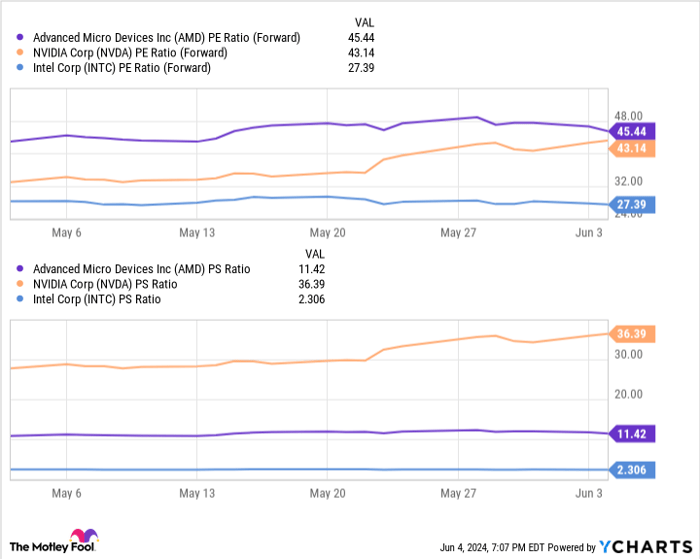
However, Nvidia’s incumbency at the industry summit and Intel’s foray into manufacturing allude to potentially more entrenched positions for these companies in AI over the long haul than AMD. Notably, Intel’s superior value proposition, with the lowest forward price-to-earnings ratio and price-to-sales ratio as compared to its peers, underscores its allure for investors seeking long-term returns.
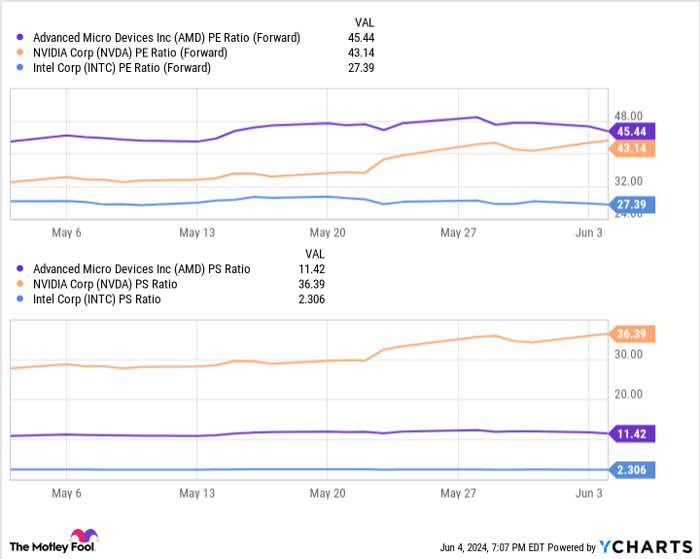
Data by YCharts; PE = price to earnings, PS = price to sales.
Given Intel’s recent strides in AI chip development and its expansion in manufacturing, the stock emerges as a superior choice over AMD, representing a compelling buy opportunity for long-term investors.
Is Investing $1,000 in Intel a Wise Move?
Prior to plunging into Intel stock, ponder over this:
The Motley Fool Stock Advisor analyst squad has pinpointed what they envision as the 10 prime stocks for investors to acquire now… and Intel didn’t make the cut. The 10 selected stocks hold the potential to churn out astronomical returns in the ensuing years.
Reflect on Nvidia’s inclusion on this roster back on April 15, 2005… had you invested $1,000 based on that recommendation, you’d now be staring at $740,688!*
Stock Advisor furnishes investors with an easily digestible roadmap for success, offering insights into constructing a portfolio, regular analyst updates, and two fresh stock picks monthly. The Stock Advisor service has outpaced the S&P 500 by more than fourfold since 2002*.
*Stock Advisor returns as of June 3, 2024
5 Stocks Our Experts Predict Could Double In the Next Year
By submitting your email, you'll also get a free pivot & flow membership. A free daily market overview. You can unsubscribe at any time.