China’s economy has hit a speed bump, with GDP growth in Q2 2024 coming in at 4.7%, below expectations and showing a deceleration compared to the prior quarter. In response, the People’s Bank of China (PBOC) unexpectedly slashed interest rates on July 22, aiming to revitalize the economy. The PBOC reduced its seven-day reverse repo rate by 10 basis points to 1.7%, and the one-year and five-year loan prime rates (LPR) to 3.35% and 3.85%, respectively.
This move is anticipated to have widespread implications across sectors, with technology stands out as a potential major beneficiary. Chinese tech firms have been grappling with regulatory challenges and economic headwinds, but the infusion of liquidity and stimulus measures could offer them a much-needed lifeline. Despite this, the sector remains undervalued compared to its U.S. counterparts and historical levels, presenting an intriguing prospect for investors willing to embrace the added geopolitical risks.
The Impacts of Rate Cuts on Tech Stocks
What does the loosening of monetary policy imply for Chinese technology stocks? Potentially, quite a lot. These rate cuts act as a catalyst, making borrowing more affordable and fostering increased expenditure and investment. For technology companies, this might translate into more resources for research and development, expansion endeavors, or even mergers and acquisitions.
However, the implications go beyond mere R&D or M&A activities. When interest rates decline, investors often seek higher returns through growth-oriented stocks. As tech stocks that appeared risky yesterday now seem more enticing today, the resulting uptick in sector investments can drive up stock prices overall.
Furthermore, reduced rates tend to boost consumer spending. In a landscape where e-commerce reigns supreme, and mobile payments are ubiquitous, heightened consumer activity directly benefits numerous tech enterprises. Picture swathes of additional consumers shopping on Alibaba (BABA) or JD.com (JD), or utilizing services like Meituan for food deliveries.
Recognizing tech as a pivotal growth driver, the PBOC established a $69 billion re-lending initiative earlier this year, tailored specifically for tech firms. This initiative aims to furnish tech companies with low-cost loans, fostering innovation and expansion.
Overview of the KraneShares CSI China Internet ETF (KWEB)
The KraneShares CSI China Internet ETF (KWEB) presents investors with a distinctive opportunity to tap into China’s internet domain. With a substantial $4.80 billion in assets and an average volume exceeding 16 million shares, KWEB boasts significant liquidity and appeals to investors eyeing a slice of the Chinese tech investment realm.
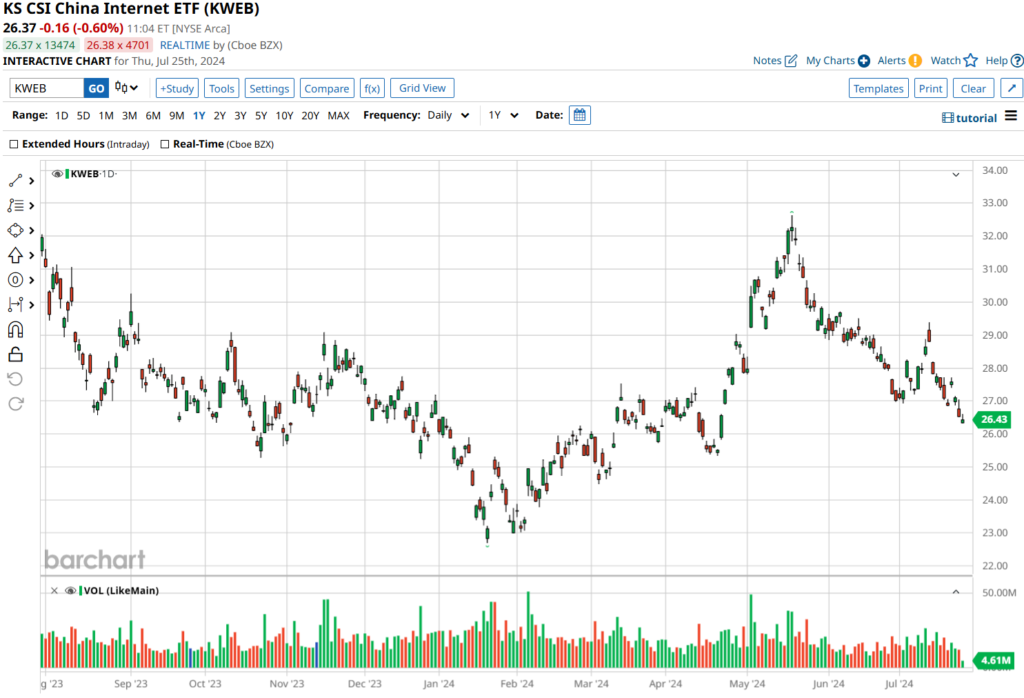
Over the past 52 weeks, KWEB has shed 12.3%, marking a nearly 50% decline over the last three years. Despite a 17% rebound from its 52-week low in January, KWEB has retreated by 19% from its year-to-date peak in May, yielding a modest 2% year-to-date return in the negative spectrum. Consequently, holding KWEB shares might be for the stout-hearted alone.

KWEB’s methodology is candid yet potent: it tracks the CSI Overseas China Internet Index, concentrating on China-based companies operating in the internet and its ancillary sectors. This strategy enables investors to delve into both U.S. and Hong Kong-listed shares of Chinese internet giants, cultivating a diversified yet focused portfolio.
Highlighting the portfolio, KWEB’s top holdings feature stalwarts of Chinese tech. Tencent Holdings (TCEHY) leads the pack with 10.22%, followed by Alibaba Group (BABA) at 9.72%. Other notable contenders in the mix are the Temu parent company PDD Holdings (PDD) at 8.06%, Meituan at 7.30%, and JD.com (JD) at 5.64%. The roster extends to include NetEase (NTES) at 4.55%, Tencent Music Entertainment Group (TME) at 4.41%, Baidu (BIDU) at 4.01%, Trip.com Group (TCOM) at 3.90%, and KE Holdings (BEKE) at 3.84%. Combined, these top 10 holdings represent over 61% of the fund’s total assets, indicating a concentrated wager on the leading players in the sector.
For income-oriented investors, KWEB features an annual dividend. The most recent payout amounted to $0.46 per share, equating to a dividend yield of around 1.67%. While not a high-yield option, this dividend introduces an income facet to the growth-centric ETF.
That said, these gains come at a price. KWEB’s expense ratio stands at 0.69%, which, though not the most economical, is reasonable given the specialized exposure it furnishes into China’s tech arena.
KWEB’s stratagem of providing exposure to U.S. and Hong Kong-listed shares of Chinese internet enterprises is particularly noteworthy. This dual-listing framework endows flexibility and could mitigate risks, empowering the fund to navigate regulatory hurdles and market volatilities with agility.
Is KraneShares CSI China Internet ETF (KWEB) a Lucrative Play on Chinese Tech Stocks?
Summing up, the KraneShares CSI China Internet ETF (KWEB) presents a compelling prospect for investors anticipating a resurgence in Chinese tech stocks. Bolstered by sizeable assets under management, a deliberate focus on preeminent Chinese internet firms, and the potential tailwinds from recent PBOC monetary incentives, KWEB is poised to capitalize on any favorable market shifts. Nevertheless, traders must account for the specific geopolitical risks inherent here and proceed with due diligence.
5 Stocks Our Experts Predict Could Double In the Next Year
By submitting your email, you'll also get a free pivot & flow membership. A free daily market overview. You can unsubscribe at any time.