Throughout the early months of 2024, as broader markets soared to “record highs,” a starkly contrasting narrative unfolded for emerging green energy entities, with many plummeting to unprecedented depths. Nikola (NKLA) stands out conspicuously among them. In a hypothetical future chronicle of the electric vehicle (EV) bubble, Nikola might warrant a dedicated chapter.
As an early adopter of the special purpose acquisition company (SPAC) surge in 2020, Nikola epitomized the euphoria surrounding renewable energy – akin to GameStop’s (GME) role in the meme stock frenzy.
During its peak in 2020, Nikola’s market capitalization exceeded that of Ford Motor (F), perhaps the initial red flag signaling an imminent bubble within the EV sector, notably as Nikola hadn’t commenced vehicle deliveries at that stage.

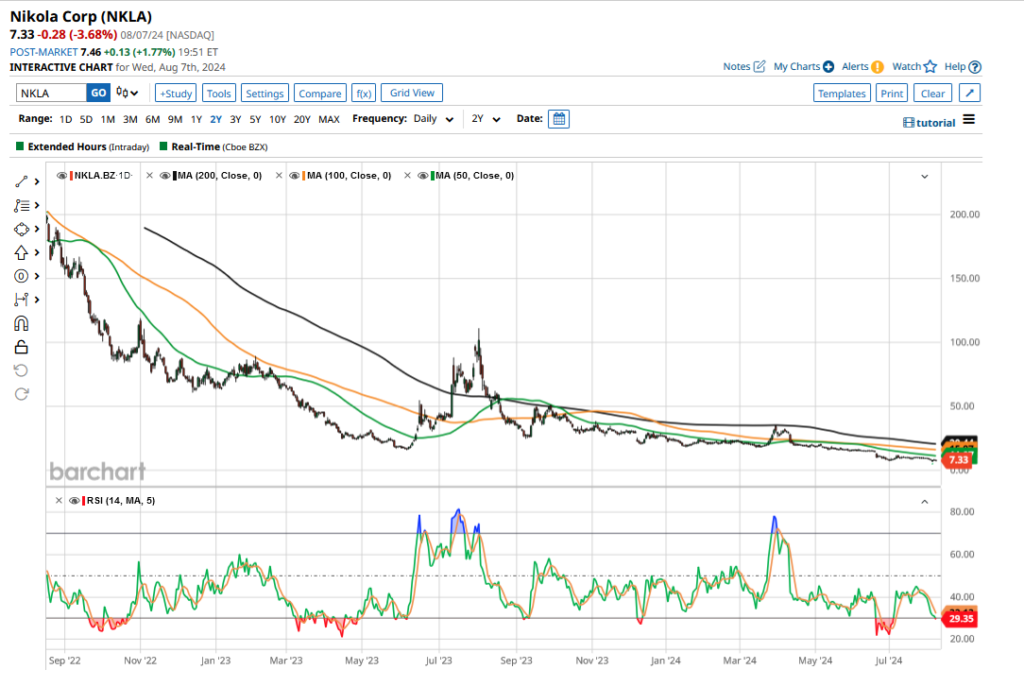
Since its zenith, Nikola’s stock has been on a downward trajectory, currently boasting a market capitalization under $350 million. The imminent Q2 earnings release on Friday has generated curiosity in the market. Let’s delve into the market’s expectations for the upcoming earnings report and whether NKLA stock presents a viable investment proposition.
Nikola Q2 Earnings Overview
Market analysts anticipate Nikola to unveil revenues of $24.6 million for the June quarter, marking a 60.5% surge compared to the corresponding period last year. In Q2, the company successfully sold 72 Class 8 Nikola hydrogen fuel cell trucks to wholesale clients, surpassing its guidance estimates.
Consensus projections indicate a projected net loss of $120.6 million for Q2, reflecting a 13.4% year-over-year escalation. It is now commonplace for emerging green energy firms to report substantial losses, necessitating frequent capital market forays to bolster funds – a trend Nikola has enthusiastically adopted.

Nikola has undertaken a relentless share selling spree, resulting in a marked upsurge in its outstanding share count. Consequently, should Nikola eventually achieve profitability, these earnings would be distributed amongst the expanded share base, consequently diluting the per-share earnings.
Nikola’s Strategic Volume Generation
Unsurprisingly, profit generation is not the primary focus of Nikola’s leadership panel. Confronted with an existential battle, the management orchestrated a reverse stock split in June to meet the mandatory exchange listing standards. Moreover, the management has signaled a willingness to compromise pricing to stimulate initial sales volumes.
During Nikola’s Q1 2024 earnings briefing, CFO Tom Okray underscored, “Profitability remains elusive until we achieve scalability. Enhancing our cost efficiency without considerable volume remains implausible.”
While Tesla (TSLA), renowned for its industry-leading margins, has the flexibility to prioritize volumes over margins, Nikola, grappling with perpetual losses and a frail balance sheet, lacks such luxuries and finds itself in an arduous position.
NKLA Stock Projection
Nikola garners coverage from merely five analysts, with a solitary “Strong Buy” rating alongside four “Hold” endorsements. Despite Wednesday’s closure at a lower price point, the mean target valuation stands at $18.01, reflecting an optimistic outlook with a 145% potential surge.

Admittedly, Nikola has undertaken substantial business overhauls, shifting its focus to commercializing hydrogen fuel trucks while concurrently developing hydrogen infrastructure in North America under the Hyla brand, a potentially monetizable asset if the hydrogen market gains traction. Securing a pioneering status in North American green Class 8 truck manufacturing, Nikola could yield significant returns if it successfully scales truck sales.
Crucial Risks for Nikola Investors
While Nikola’s outlook seems promising, investors must remain vigilant regarding various inherent risks, commencing with operational execution. The company must effectively market its hydrogen fuel trucks, a technology met with skepticism by some individuals, including Elon Musk.
Another threat to Nikola could manifest if Donald Trump secures victory in the upcoming election, given his allegiance to fossil fuel-centric energy policies over green energy initiatives. Nonetheless, irrespective of the electoral outcome, the transition to cleaner energy continues, with policy measures amplifying or abating this shift.
The third critical concern for Nikola investors revolves around the company’s feeble balance sheet and ongoing cash depletion, perpetuating the looming specter of insolvency. Finally, considering the recent market volatility surge, financially frail corporations might encounter skepticism from investors, given the attractive valuations accessible in quality stock offerings.
While Nikola may appear reasonably priced based on its upcoming 12-month price-to-sales multiple of 1.66x, exercising prudence seems advisable concerning this embattled firm, notwithstanding the currently favorable risk-reward profile for investors with an appetite for high risk ventures.
5 Stocks Our Experts Predict Could Double In the Next Year
By submitting your email, you'll also get a free pivot & flow membership. A free daily market overview. You can unsubscribe at any time.