Diving Deeper into SMCI’s Plunge and Nvidia’s Earnings
The realm of artificial intelligence (AI) took a hit today as Super Micro Computer (SMCI), a market-beloved entity, faced turmoil amid escalating fraud concerns.
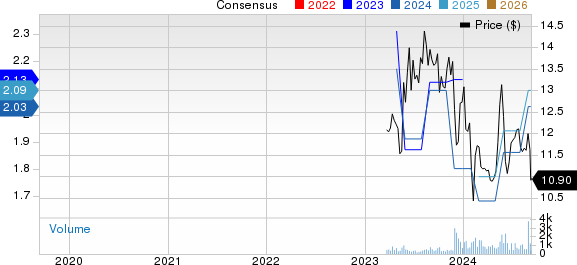
Amidst the afternoon breeze on Wednesday, SMCI tumbled 25% in response to the company postponing the submission of its annual report to the Securities and Exchange Commission.
Usually, such a delay might raise a few eyebrows, but its impact wouldn’t be as seismic. What distinguishes this occasion is that the news follows just a day after short-seller Hindenburg Research unleashed a scathing critique on SMCI.
Per Quartz, Hindenburg Research’s accusations against Super Micro Computer span accounting discrepancies and questionable business transactions, including potential sanctions violations from dealings with Russian and Chinese businesses.
The report states: “[Hindenburg Research] found ‘glaring accounting red flags, evidence of undisclosed related party transactions, sanctions and export control failures, and customer issues,’ according to a report released Tuesday.”
Within Hindenburg’s report, a stark claim emerges: “All told, we believe Super Micro is a serial recidivist.”
Navigating Troubled Waters: SMCI’s History with the SEC
In the annals of 2018, Nasdaq briefly expelled SMCI from its listings due to the company’s failure in adhering to financial statement filings.
Regulators later accused SMCI of “widespread accounting violations,” including the improper reporting of revenue, leading to a hefty $17.5 million fine.
Hindenburg’s recent report points fingers at this past violation and alleges that SMCI’s governance troubles have not evaporated since then.
Returning to the present, SMCI’s declaration of a delay in filing its fiscal year 2024 10-K report is attributed to additional time needed for evaluating internal controls over financial reporting.
Although the optics seem murky, the significance of this delay remains uncertain.
In a recent Flash Alert podcast, legendary investor Louis Navellier pondered that “it’s possible that [SMCI’s] CFO wants to make sure that he doesn’t give Hindenburg any credibility,” underscoring that SMCI retains over 100% sales growth.
This narrative will unfold further with new revelations as they surface.
Shifting Focus: The Awaited Announcement from Nvidia
Nvidia (NVDA) is slated to unveil its Q2 earnings post the closing bell today. At this juncture, the outcomes remain veiled due to our time constraints, yet history suggests an imminent spectacle.
Reviewing NVDA’s performance following earnings in the last 12 quarters, the chipmaker has oscillated by an average of approximately 8%.
As you delve into this, you’re poised for a retrospective comparison between the preemptive forecasts and the actual outcomes.
Recently, Louis hinted that this quarter’s earnings release from Nvidia will pivot less on past earnings and more on their vision for the future.
Stressing the importance of guidance, Louis articulated, “Nvidia’s earnings are going to be more about the guidance than anything else.” He emphasized the critical aspect of Blackwell chip sales and significant orders from tech giants like Google and Meta.
If NVDA’s projection points towards escalating demand translating to heightened earnings forecasts, a promising market surge could be on the horizon. However, if disappointment looms, the repercussions could be harsh. Nvidia’s eminence in the AI realm positions it as a cornerstone of Wall Street’s investment landscape.
Tomorrow, the market’s trajectory is prone to be in sync with Nvidia’s fortunes.
Celebrating Milestones: Berkshire Hathaway’s Triumph
Earlier today, Berkshire Hathaway achieved a historic feat by becoming the first non-tech entity to reach a $1 trillion market valuation.
It joins the ranks of esteemed tech giants like Apple, Nvidia, Microsoft, Alphabet, Amazon, and Meta in this elite echelon.
While Berkshire isn’t a tech-centric conglomerate, its heavy stake in Apple deems it “tech adjacent.” Apple constituted half of Berkshire’s assets in December, and despite Buffett’s substantial Apple sell-off this year, the tech titan still remains his predominant holding, constituting around 30% of his portfolio. Apart from Apple, Buffett’s tech investments encompass Amazon and Verisign.
Beyond tech, Berkshire’s primary holdings include stalwarts like Bank of America, American Express, and Coca-Cola.
If you’re a Berkshire shareholder, applause is in order, with returns outstripping the S&P’s climb by 28% this fiscal year.
Delving into Buffett’s Investment Essence
Beneath Berkshire Hathaway’s glittering exterior resides a little-known truth that eludes many investors…warren Buffett’s long-term annual return leads the S&P’s benchmark by a remarkable 19.8% from 1965 to the present.
However, beneath this lustrous veneer lies a reality most investors remain oblivious to, and fewer still could withstand…
In a given year, Buffett frequently trails the market…by a significant margin.
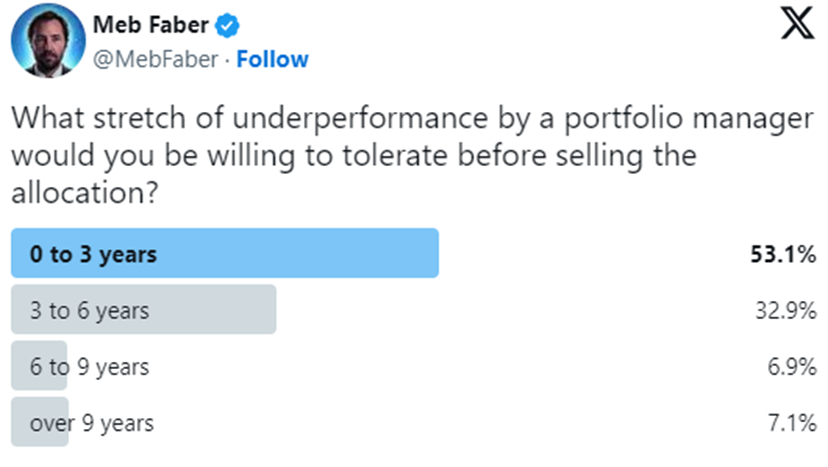
A few years back, my colleague, Meb Faber, delved into this intriguing dynamic, unveiling how investors often gravitate towards swift, lofty returns. In a poll on investor tolerance for underperformance by a portfolio manager, the majority concurred that enduring underperformance beyond 0-3 years was untenable.
Source: @MebFaber
The Investment Roller Coaster: Staying Power in Stocks
Enduring the Journey with Berkshire Hathaway
Many portfolio managers experience periods of underperformance, yet some, like Berkshire Hathaway under Warren Buffett’s helm, showcase remarkable staying power. For instance, an investor putting $10,000 into Berkshire Hathaway in 1965 would now be sitting on a staggering $200,000,000. However, the road to such wealth was far from smooth.
The Temptation to Jump Ship
During Buffett’s tenure, Berkshire Hathaway has had its fair share of underperforming years against the S&P 500. This trend can test an investor’s resolve. Would you hold onto your investment through a prolonged period of underperformance, or would you start doubting Buffett’s acumen?
Would you stay with Buffett through this period?
It’s easy to feel tempted to abandon ship when your investment lags behind for an extended period, especially when compared to the success of others. However, it’s crucial to remember the bigger picture.
Berkshire’s Long-Term Outperformance
Despite intermittent underperformance, Warren Buffett’s track record shines over the long haul. From the start of the century, Berkshire Hathaway’s stock picks have outperformed the S&P 500 by three percentage points per year, surpassing the majority of mutual funds in the process.
The Power of Staying Committed
This serves as a poignant lesson for investors. Holding onto a solid investment even through challenging times can be the key to long-term success. While short-term fluctuations may test your patience, enduring the “suck” periods can pay off handsomely in the end.
As we speculate on the future performance of Super Micro, remember that enduring turbulent times can often lead to fruitful outcomes. Stay tuned for updates on this front.
Wishing you a great evening,
Jeff Remsburg
5 Stocks Our Experts Predict Could Double In the Next Year
By submitting your email, you'll also get a free pivot & flow membership. A free daily market overview. You can unsubscribe at any time.