
As the markets embrace a bearish sentiment, it’s prudent to conduct a comprehensive review of our bear put spread screener.
Understanding Bear Put Spreads
A bear put spread is a vertical strategy designed to capitalize on a stock’s price decline. Its inherent bearish bias is indicated by the name. In contrast to the bear call spread, it is susceptible to time decay, requiring traders to accurately predict not only the direction of the underlying asset but also the timing.
The structure of a bear put spread involves buying an out-of-the-money put option and simultaneously selling a further out-of-the-money put option.
The maximum profit is determined by the difference between the strikes, less the premium paid. On the contrary, the loss is confined to the premium paid.
Short Bear Put Spread Screener Results
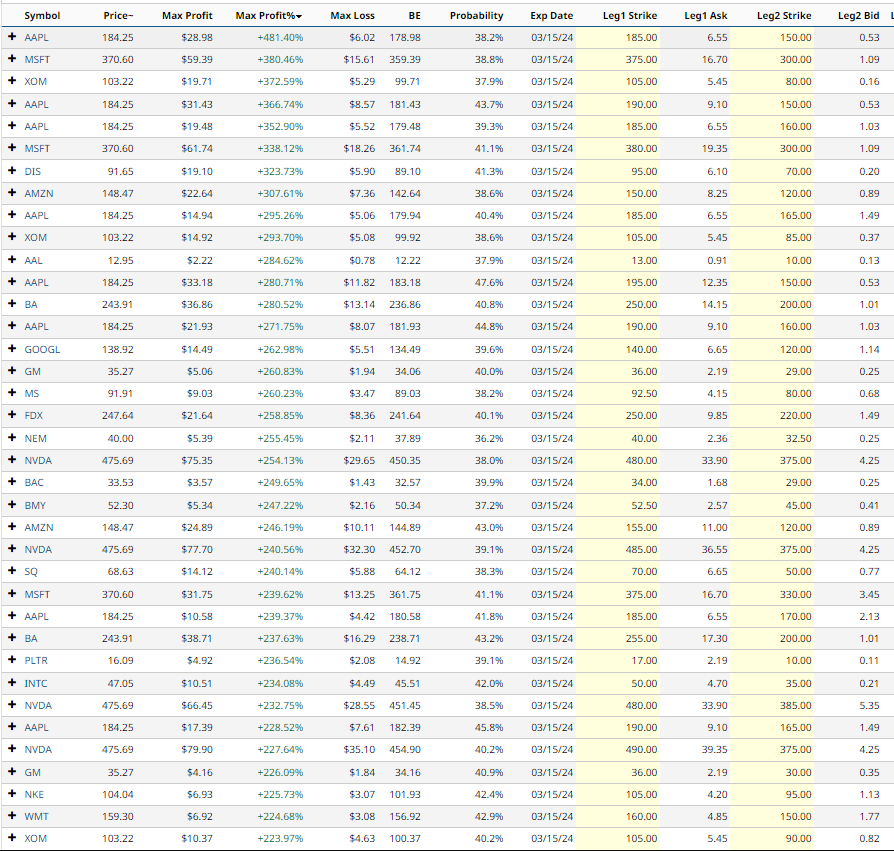
Let’s review the outcomes from Barchart’s Short Bear Put Spread Screener for today:

The screener has flagged some intriguing trades featuring impressive Max Profit Percentages. Let’s delve into the first item in the table – a bear put spread concerning Apple (AAPL).
Apple Bear Put Spread Example
Examining the trade with a March 15 expiry, it entails purchasing the $185 put and vending the $150 put. The cost of the trade stands at $6.02, equivalent to the maximum loss. The potential gain can be calculated by subtracting the premium paid from the width between the strikes:
$35 – $6.02 x 100 = $2,898.
The breakeven price for the trade is $178.98 – the long put strike less the premium.
Switching gears to the Microsoft (MSFT) example, employing the March 15 expiry involves buying the $375 strike put and selling the $300 strike put. The outlay for the trade is $1,561, representing the maximum loss; however, the maximum potential gain is $5,939 if MSFT shares dip below $300 on the expiration date.
The Barchart Technical Opinion provides an 88% Buy rating, signaling an average short-term outlook on maintaining the current direction. Long-term indicators firmly support a continuation of the trend. MSFT exhibits an IV Percentile of 58% and an IV Rank of 55%, with the current level of implied volatility at 27.33% – comparing favorably to the 52-week high of 39.07% and low of 12.98%.
Mitigating Risk
Fortunately, bear put spreads are defined-risk trades, inherently incorporating risk management. For each trade, consider implementing a stop loss at 30% of the maximum loss.
It’s crucial to reiterate the risky nature of options; investors are at risk of losing 100% of their investment. This article serves educational purposes only and is not a trade recommendation. Always conduct thorough due diligence and consult with your financial advisor before making any investment decisions.
More Stock Market News from Barchart
5 Stocks Our Experts Predict Could Double In the Next Year
By submitting your email, you'll also get a free pivot & flow membership. A free daily market overview. You can unsubscribe at any time.