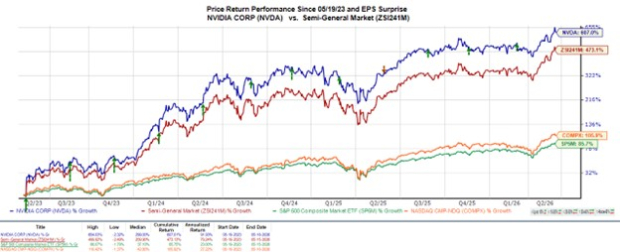
Nvidia NVDA) has become the defining stock of the artificial intelligence era, and ahead of the chip giant’s Q1 results on Wednesday, May 20, investors are once again asking whether the AI leader still has room to run after a historic rally.
The answer may depend less on whether Nvidia can deliver strong results — which Wall Street largely expects — and more on whether management can convince investors that AI infrastructure demand remains strong enough to offset geopolitical risks and intensifying competition.
Ahead of its Q1 report, Nvidia stock has pulled back roughly 6% from its recent record high of $236 a share (post-split basis), reached last week amid optimism that global AI spending continues to accelerate while restrictions on chip sales to China stabilize.
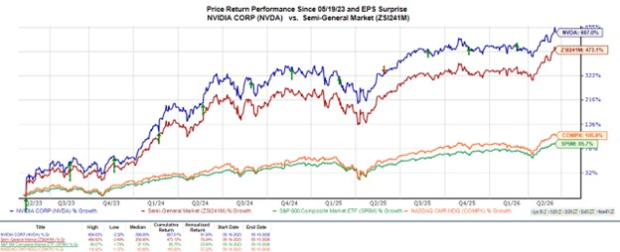
Image Source: Zacks Investment Research
Nvidia’s Lofty Q1 Expectations
Consensus forecasts call for Nvidia’s Q1 revenue to reach $78.75 billion, representing 79% year-over-year growth from $44.06 billion in the comparative quarter, with gross margins projected above 74%.
The growth outlook continues to be supported by Nvidia’s dominance in AI data center GPUs, which remain the backbone of hyperscaler AI spending.
On the bottom line, analysts expect Q1 earnings to surge 118% to $1.77 per share from EPS of $0.81 a year ago.
Notably, Nvidia has exceeded revenue estimates for 28 consecutive quarters and has delivered an average sales surprise of 3.06% across its last four quarterly reports.
Nvidia has also topped earnings expectations in three of its last four quarterly reports with an average EPS surprise of 2.93%.
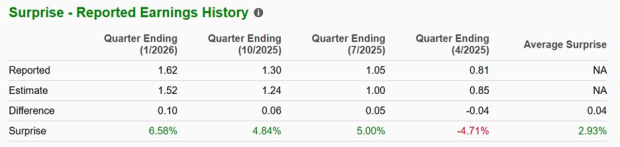
Image Source: Zacks Investment Research
Why Expectations Are So High
Hyperscaler spending remains massive: Amazon AMZN), Microsoft MSFT), Alphabet GOOGL), and Meta META) collectively plan to spend over $700 billion on AI infrastructure this year, with Nvidia remaining the primary beneficiary.
Next-generation chips are ramping: Blackwell and Rubin processors are expected to drive the next wave of data center growth, with Rubin potentially contributing revenue as early as next quarter.
Guidance may prove conservative: Nvidia guided for roughly $78 billion in Q1 revenue, though many investors believe management is sandbagging expectations.
4 Key Points of Risks to Consider
Even with strong fundamentals, Nvidia faces several pressure points:
1. Sentiment risk
Nvidia’s stock has a history of falling after earnings, even when results are excellent — a dynamic CEO Jensen Huang has acknowledged.
2. Supply-chain and margin pressure
Nvidia has roughly $117 billion in non-cancelable supply commitments, which could compress margins if hyperscale spending slows.
3. Competitive pressure — including Cerebras Systems
Competition is intensifying, particularly from AMD AMD), Alphabet’s internally developed AI chips, and emerging AI hardware companies such as Cerebras Systems CBRS).
Cerebras stock surged nearly 70% following its IPO last week, giving the company a valuation approaching $70 billion and raising broader questions about whether specialized AI compute platforms could eventually chip away at Nvidia’s dominance.
Even so, Nvidia’s software ecosystem, CUDA platform, and scale advantages remain significant competitive moats.
4. China exposure improving — but still uncertain
Investor sentiment surrounding chip sales to China has improved recently, though Nvidia’s guidance still assumes no data center compute revenue from China, underscoring ongoing regulatory and geopolitical uncertainty.
Why the market has remained Bullish
Despite these risks, bullish sentiment around Nvidia remains intact. To that point, Nvidia continues to dominate one of the fastest-growing areas of technology, while hyperscaler AI spending appears to be accelerating rather than slowing.
At the same time, next-generation chip platforms such as Blackwell and Rubin could further extend Nvidia’s competitive lead. Historically, Nvidia has also consistently exceeded Wall Street’s expectations and rewarded long-term shareholders.
Bottom Line
As with any stock trading near record highs, NVDA requires a higher tolerance for volatility and valuation risk. Still, Nvidia stock currently carries a Zacks Rank #2 (Buy), supported by positive earnings estimate revisions for its current FY27 and FY28.
Even if NVDA experiences a post-earnings pullback, long-term investors may ultimately view any weakness as a buying opportunity for a company that continues to dominate the AI infrastructure boom.
7 Best Stocks for the Next 30 Days
Just released: Experts distill 7 elite stocks from the current list of 220 Zacks Rank #1 Strong Buys. They deem these tickers “Most Likely for Early Price Pops.”
Since 1988, the full list has beaten the market more than 2X over with an average gain of +23.9% per year. So be sure to give these hand picked 7 your immediate attention.
NVIDIA Corporation (NVDA) : Free Stock Analysis Report
Amazon.com, Inc. (AMZN) : Free Stock Analysis Report
Advanced Micro Devices, Inc. (AMD) : Free Stock Analysis Report
Microsoft Corporation (MSFT) : Free Stock Analysis Report
Alphabet Inc. (GOOGL) : Free Stock Analysis Report
Meta Platforms, Inc. (META) : Free Stock Analysis Report
This article originally published on Zacks Investment Research (zacks.com).
5 Stocks Our Experts Predict Could Double In the Next Year
By submitting your email, you'll also get a free pivot & flow membership. A free daily market overview. You can unsubscribe at any time.