U.S. auto giants General Motors GM and Ford F are strategically shifting their focus toward hybrids and plug-in hybrid electric vehicles (PHEVs). That’s not to say that these companies are not enthusiastic about an all-electric future of mobility. It is just that GM and F are refining their strategies amid a cooling EV market due to consumer concerns about the high prices of EVs and the availability of charging infrastructure.
During the Bernstein Annual Strategic Decisions Conference held on May 29, both companies emphasized increasing their focus on hybrids, with Ford showing a stronger commitment to the idea.
Differing Approaches to Hybrid Evolution
GM plans to introduce plug-in hybrids by 2027 to comply with regulatory requirements and customer demands during the transition to full electrification. GM CEO Mary Barra emphasized that EVs remain the company’s long-term priority and views hybrid technology as merely a transitional phase.
In contrast, Ford CEO Jim Farley views hybrids as not just a transitional technology but a significant part of the company’s future. He argued that hybrids should not be seen merely as a bridge to full electrification.
Charting the Path to Growth
Both GM and Ford are committed to long-term electrification strategies, recognizing it as a pivotal growth driver. They acknowledge the rising significance of software and subscription services for future profitability.
GM’s Ultium Drive system and battery facilities across Ohio, Tennessee, and Lansing are poised to bolster its electric mobility capabilities. Additionally, GM is refining its software-defined vehicle approach, prioritizing seamless updates and user experience enhancements.
Ford also remains focused on integrating digital technologies for streamlined manufacturing and prioritizing in-house production of essential components. It is enhancing energy efficiency and lowering production costs for competitive pricing through supply chain and manufacturing optimizations.
Investment Outlook for GM & F
Both these legacy automakers are strategically positioning themselves to benefit from robust vehicle offerings, cost-containment efforts, and a balanced approach toward hybrids and EVs. As these companies navigate the evolving automotive landscape, their hybrid strategies could provide a competitive edge in the near term.
Both companies are witnessing northbound estimates for the current fiscal. Over the past 30 days, the Zacks Consensus Estimate for GM’s 2024 EPS has been revised north by 2 cents to $9.40. The consensus mark for F’s 2024 EPS has moved up by 3 cents to $1.97 over the same timeframe.
From a financial standpoint also, GM and F are on strong grounds. General Motors had total automotive liquidity of $33.3 billion as of Mar 31, 2024, including around $19.7 billion of cash/cash equivalents/marketable debt securities. Ford ended the first quarter of 2024 with around $25 billion in cash and more than $43 billion in liquidity.
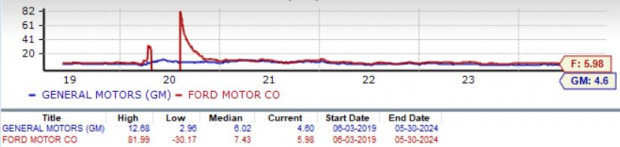
Both companies are currently valued well below their 5-year median values. Over the past six years, shares of GM and Ford have gained 34.1% and 11.2%, respectively, indicating potential for further growth.
GM and F currently carry a Zacks Rank #3 (Hold) each.
5 Stocks Our Experts Predict Could Double In the Next Year
By submitting your email, you'll also get a free pivot & flow membership. A free daily market overview. You can unsubscribe at any time.