The whipping post

Unraveling the Yen Carry Trade: A Financial Analysis

The Rise and Fall of the Yen Carry Trade

Exploring the resurgence of the yen carry trade, its origins, unraveling, and the implications for the financial market

Can the current market chaos be attributed to the unwinding of the yen carry trade despite the Fed’s interventions to stabilize the economy?

Insights from notable economists shed light on this phenomenon, indicating potential risks and repercussions associated with carry trade unwinding.

Recent statements from financial experts underscore the severity of the situation, emphasizing the impact on risk assets in the context of global economic factors.

Reflecting on the market turmoil in August, we witnessed significant downturns in major indices, partly catalyzed by the unwinding of the yen carry trade.

The recent resurgence of discussions surrounding this trade prompts a deeper analysis to comprehend the events of August and anticipate possible future repercussions.

Our objective remains to discern market risks accurately, avoiding premature bear market assumptions and hasty portfolio exits driven by temporary anomalies like the yen carry trade.

Demystifying the Mechanics of the Yen Carry Trade and its August Disruption

Arguably one of the most widely embraced trades in modern finance, the yen carry trade found its allure in arbitrage opportunities.

Participants would borrow funds in yen, benefiting from near-zero borrowing costs, and channel these funds into high-yielding assets internationally, notably the U.S. stock market.

The core principle was simple: secure substantial returns from the investment, repay the yen loan at a minimal cost, and retain the profit margin.

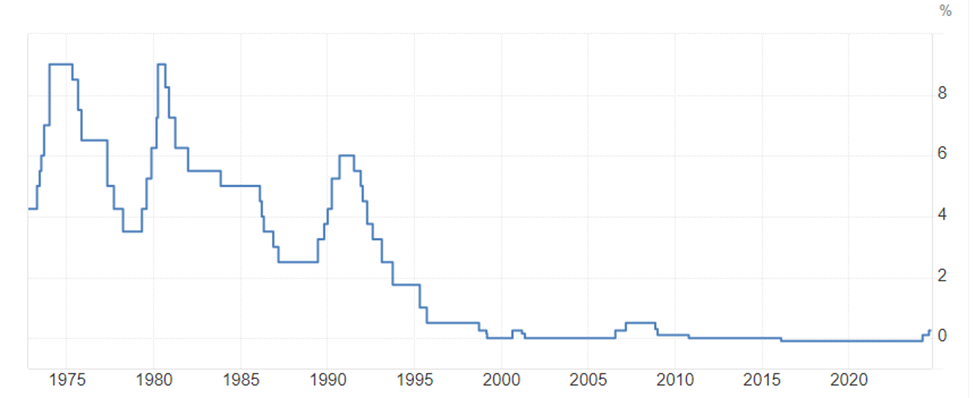
By examining the Bank of Japan’s historical short-term interest rates, which have been close to zero since 2000, the attractiveness of the yen carry trade becomes evident.

This trade garnered global interest, with investors worldwide capitalizing on the opportunity to borrow inexpensively in yen and invest in lucrative U.S. equities.

Assessing the magnitude of the yen carry trade proves challenging, with analyst estimates diverging widely between $1 trillion and $4 trillion. Nevertheless, the overarching narrative highlights substantial capital involvement in this trade.

Unraveling the Lucrativeness of the Yen Carry Trade

Recalling the historic Japanese market bubble of the late 1980s serves as a vivid precursor to the yen carry trade’s attractiveness.

The exponential growth of the Nikkei 225 index during that period, coupled with exorbitant price-to-earnings ratios of prominent Japanese stocks, exemplified the speculative fervor and subsequent fallout.

The burst of this bubble plunged Japan into a prolonged period of deflation and economic stagnation, prompting the Bank of Japan to adopt 0% interest rates as a stimulus measure.

This environment, characterized by negligible inflation and depressed yields, laid fertile ground for the emergence of a robust and enduring yen carry trade, drawing widespread participation from global investors.

Fast-forwarding to recent years, the yen carry trade faced new challenges as Japanese inflation exhibited signs of life, prompting the Bank of Japan to take corrective measures.

Echoes of Change: Japanese Inflation, BOJ’s Response, and the Yen Carry Trade’s Vulnerabilities

Following decades of minimal inflation, Japan experienced a shift post-pandemic, with supply chain disruptions driving up commodity prices worldwide.

The geopolitical upheaval intensified as energy costs surged post-Russia’s actions, impacting Japan as a major energy importer. Concurrently, the yen’s depreciation against the dollar further escalated costs.

In response, the Bank of Japan intervened, triggering a significant appreciation in the yen’s value to combat its prolonged depreciation.

The subsequent interest rate hike by the Bank of Japan signified a significant policy shift, increasing rates to approximately 0.25% from a decade-long range of 0% to 0.1% and outlining plans to curtail bond purchases.

This hike, marking the highest rates since 2008, has reverberated through the yen carry trade, fundamentally altering its cost dynamics.

Visualizing the yen’s dollar valuation over the past year accentuates the impact of the BOJ’s actions, underscoring the escalating costs associated with the yen carry trade.

One may interpret this trajectory as “the systemic repercussions of the yen carry trade coming to fruition.”

The Unwinding Yen Trade and Market Dynamics the yen priced in dollars over the last year. The vertical spike I've circled is the effect of the BOJ's actions.

Source: StockCharts.com

The Unwinding Yen Trade and Market Dynamics

The Consequences of Yen Appreciation

July brought on a sudden surge in the yen’s value, fueled further by the BOJ’s rare rate hike at the month’s end. This unexpected turn spooked recent investors in the yen carry trade, leading them to liquidate their positions due to higher costs associated with the strengthened currency.

These investors not only offloaded Japanese stocks but also a significant amount of U.S. tech stocks, triggering an 8% downturn in the Nasdaq between August 1 and August 5, closely following the BOJ’s monetary policy move.

Is the Carry Trade Unwound?

The burning question on everyone’s mind is whether the carry trade has completed its unwinding process. JPMorgan’s Arindam Sandilya suggests that we may only be halfway through the process, implying more turbulence ahead.

The critical factors determining the trade’s completion include the initial yen acquisition price and the peak yen valuation during the trade. With the yen currently at a near two-year peak against the dollar and showing upward momentum, traders are likely under pressure to act.

Regarding future rate changes, the BOJ maintains a stance of not raising rates amidst market instability. However, the potential for increased market volatility linked to the yen remains high.

Preparedness for Market Volatility

While awareness of these unfolding events is crucial, the goal is not to incite panic selling but to equip investors with insight to navigate potential market weaknesses. Adhering to stop-loss orders and maintaining diversified portfolios remain prudent strategies amid uncertain market conditions.

Meanwhile, the relationship between the yen and the tech-heavy Nasdaq 100 index indicates a challenging period for tech stocks. However, amidst this upheaval, there may be opportunities in smaller AI stocks, signaling a shift in investment dynamics.

See also  1 Reason Wall Street Is Obsessed With SoundHound AI

As market events continue to unfold, having a clear strategy can help investors navigate uncertain terrains and potentially capitalize on emerging trends.

Investors are encouraged to stay informed, adapt to changing market dynamics, and approach investment decisions strategically and thoughtfully to weather prevailing headwinds and seize opportunities that may arise.

The yen is at its second highest level relative to the dollar since August of 2023, and momentum is clearly 'up.

Source: StockCharts.com

5 Stocks Our Experts Predict Could Double In the Next Year

By submitting your email, you'll also get a free pivot & flow membership. A free daily market overview. You can unsubscribe at any time.