Intel‘s (NASDAQ: INTC) business has experienced a tumultuous decline in recent years. Once a reigning monarch in the chip market, reigning over central processing units (CPUs) alongside a profitable partnership with Apple, the company now finds itself at a crossroads. An influx of new competitors and the cessation of its Apple collaboration have compelled Intel to reassess its business strategies.
With Intel’s shares plummeting roughly 28% in the past two years as the market grappled with the company’s challenges, Intel responded with a substantial transformation poised to potentially transform it into a standout long-term investment.
The tech behemoth is pivoting its operations to prioritize a digital foundry model, a move that could position it as the largest semiconductor company in both the U.S. and Europe. Concurrently, Intel is making significant investments in the burgeoning artificial intelligence (AI) sector.
Delving into the Impact of the CHIPS Act
Two years ago, President Joe Biden signed the CHIPs Act to bolster the nation’s semiconductor manufacturing capacity by injecting $53 billion into some of the world’s top chipmakers. The disbursement of funds is now commencing.
On April 15, the Biden administration unveiled plans to allocate $6.4 billion to Samsung to expand its U.S.-based manufacturing facilities. Intel is likely poised to follow suit, with $8.5 billion allocated to the company for the construction of four new facilities across the nation.
These investments will streamline and streamline U.S. tech firms’ ability to manufacture an array of products, including consumer electronics, automobiles, data centers, and AI-related hardware.
Intel anticipates that transitioning to an internal foundry model will result in savings of up to $10 billion by 2025, marking its “most profound shift in its 55-year history.” Furthermore, this move holds the potential to enhance efficiency and profitability, potentially enabling the company to achieve a 60% non-GAAP (adjusted) gross margin and a 40% operating margin.
Significance of Intel’s Expanded Presence in the $200 Billion AI Market
Aside from the momentous shift in its business model, Intel is magnifying its focus on AI across many products.
The AI market hit an approximate valuation of $200 billion last year, with projections indicating a compound annual growth rate (CAGR) of 37% through 2030. Numerous tech firms are realigning their operations around this high-growth segment to harness AI’s vast potential. Intel is no exception.
What sets Intel apart is its extensive history in the chip market, boasting 55 years of experience as a chipmaker. Remarkably, the company commands a 63% share of the CPU market despite the ascent of competitors like Advanced Micro Devices.
Intel’s foray into AI arrives slightly later compared to its focus on CPUs. AI models primarily necessitate graphics processing units (GPUs), a domain currently dominated by Nvidia with minimal competition. However, Intel intends to challenge Nvidia’s market share with its own AI GPUs by 2024.
Last year, Intel launched its Gaudi 3 AI GPUs, surpassing Nvidia’s GPUs by 50% in inference and 40% in power efficiency.
Intel stands to capitalize on the propitious winds of the AI sector for years to come, rendering its stock an enticing choice at present.
Intel’s Position as One of the Best-Valued AI Stock
The Nasdaq-100 Technology Sector index has surged by approximately 40% over the past year, primarily fueled by enthusiasm surrounding AI. Yet, the anticipated growth in the market suggests that it is not too late to invest.
Furthermore, investing in chip stocks presents one of the optimal avenues to participate in the AI realm, given that these companies develop the core hardware underpinning transformative technology.
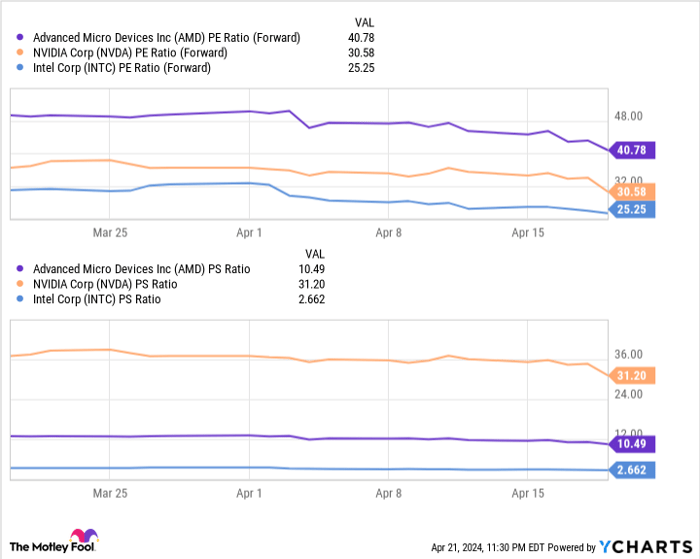
Data by YCharts
This chart underscores Intel’s position as potentially the most attractively valued AI chip stock. Intel’s forward price-to-earnings and price-to-sales ratios significantly undercut those of its chipmaking counterparts Nvidia and AMD.
Given its transition to a digital foundry model and its expanded foothold in AI, Intel’s stock beckons consideration before the window of opportunity closes.
Contemplating an Investment in Intel: A Strategic Choice?
Before diving into Intel stock, contemplate the following:
The Motley Fool Stock Advisor analyst team have pinpointed what they believe to be the top10 stocks investors should acquire at present… and Intel did not clinch a spot. The selected 10 stocks hold the potential to yield substantial returns in the years ahead.
Stock Advisor extends investors a straightforward roadmap to success, offering insights on portfolio construction, analyst updates, and two fresh stock picks each month. The service has surpassed the S&P 500’s returns by more than triple since 2002*
*Stock Advisor returns as of April 22, 2024
Dani Cook has no stake in any of the mentioned stocks. The Motley Fool holds positions in and advocates for Advanced Micro Devices, Apple, and Nvidia. The Motley Fool endorses Intel and advices the following options: long January 2025 $45 calls on Intel and short May 2024 $47 calls on Intel. The Motley Fool adheres to a transparency policy.
5 Stocks Our Experts Predict Could Double In the Next Year
By submitting your email, you'll also get a free pivot & flow membership. A free daily market overview. You can unsubscribe at any time.