Image

“The future is shaped by those who act together. That progress depends on trust — maintaining trust and amplifying trust in the system.”
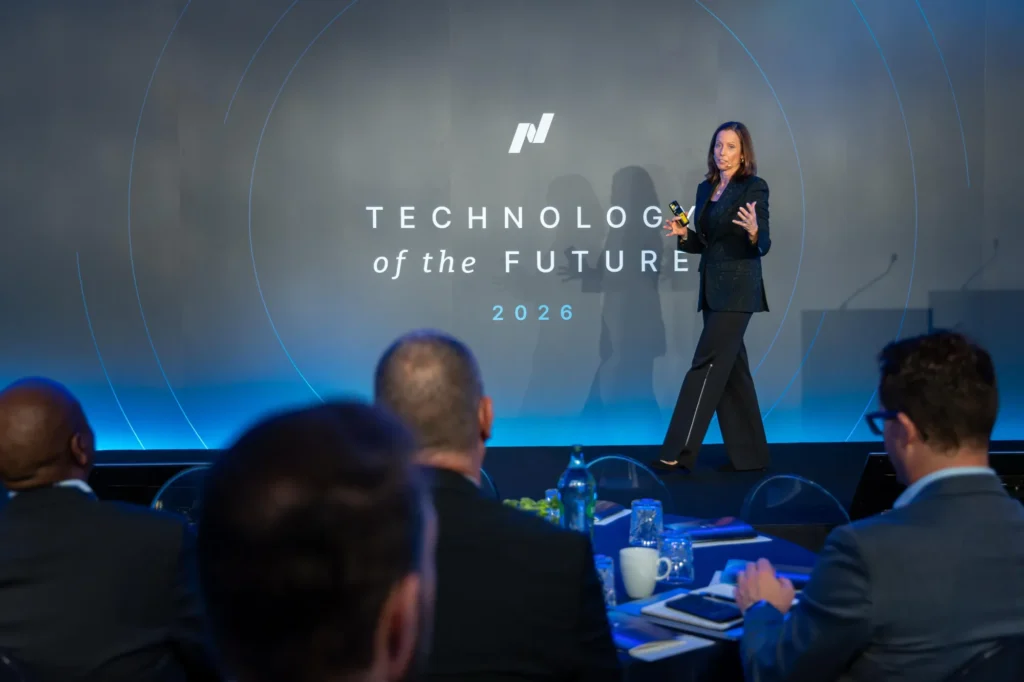
That was the message Nasdaq Chair and CEO Adena Friedman delivered at this year’s Technology of the Future conference, where Nasdaq leaders, clients and peers across the market eco-system explored how technology is transforming global markets and what it will take to ensure those innovations scale responsibly. There, Friedman laid out a vision for where markets are headed — from the physical trading floors of the past, through the early, siloed electronic venues, toward what she described as a fully interconnected global network of markets, investors and asset classes.
“We envision a future where all of our markets are connected; all investors are connected; all asset classes are connected,” Friedman said. “Every single barrier is really going to break down.”
That evolution, Friedman explained, will be spurred by four key technologies poised to reshape market infrastructure over the coming decade: AI, digital assets, low Earth orbit satellite networking, and quantum computing. While each is transformative on its own, she argued their convergence will create an exponential shift that market participants need to prepare for today.
To help navigate this evolution, Friedman outlined four “always-on” priorities guiding Nasdaq’s strategy:
- Always-on access: As the countdown to Nasdaq’s launch of 23 hours a day, 5 days a week trading continues, Friedman highlighted the importance of shifting to real-time risk management and surveillance. “You can’t have batch processing in an always-on world. You have to have continuous processing.” She cited the scale of what’s at stake: $4.7 quadrillion processed through U.S. markets in 2025, and $2.1 quadrillion flowing through payment systems globally each year.
- Always-on intelligence: Building a modern data foundation that can be unlocked with AI, both internally and for clients accessing it through tools like Model Context Protocol (MCP)layers.
- Always-on resilience: Treating AI-driven security risk as a collective, industry-wide responsibility. Friedman referenced security sessions later in the conference with Nasdaq’s CISO and Alvaro Del Hoyo, CrowdStrike’s Southern Europe Field CTO, and described a recent eye-opening conversation with a hyperscaler’s CIO that left her more resolute than ever in ensuring that Nasdaq is hypervigilant to these emerging threats.
- Always-on integrity: Fighting financial crime at scale. Friedman cited Nasdaq’s own research putting global money laundering at $4.4 trillion and fraud at $579 billion, and pointed to Verafin, Nasdaq’s AI-driven anti-financial-crime platform, used by 2,800 banks, and Nasdaq’s shift from rules-based to behavior-based market surveillance as its response.
Preparing for 23/5 with a Digital Twin and Simulated Market Conditions
The always-on evolution in financial infrastructure, Friedman emphasized, will require mutual trust to succeed.
For Nasdaq, that idea of trust is something engineered directly into the company’s technology. Nasdaq President Tal Cohen explained: a shared horizontal “trust layer” — covering identity, authorization, traceability and guardrails — that sits beneath every AI capability Nasdaq builds.
“It’s really a unified way in which we develop AI,” he said on stage at the Technology of the Future conference. “Everybody’s doing it the same way, everybody understands how we want to scale this… and then you can give a consistent answer across all of your capabilities to your clients.”
Image

Another crucial example of Nasdaq building for trust comes as the company is preparing to kick off 23/5 trading in early December. Cohen outlined four key areas of focus for the initiative: operational readiness, industry coordination, technology resilience, and the investor and issuer experience.
On the technology side, Cohen explained that Nasdaq is running a different matching engine overnight than during the day, in part to avoid propagating risk from the thinner overnight session into core trading hours.
To stress-test the system, the team built a “digital twin” of its production trading environment, populated with persona-driven agents that inject orders to simulate a range of market conditions — including edge cases — before new code ships. “That gives us confidence that we can do it really, really quickly,” he said.
All this preparation, Cohen explained, will be key for the significant shift in market hours: “Even if 10% of the total volumes are overnight, that’s a massive amount of liquidity… you’re talking about hundreds of millions of shares.”
The Promise of Tokenization
As the always-on ecosystem evolves, digital assets are poised to be an important part of that development, Friedman explained, pointing to their ability to create a more seamless and programmable financial system.
“The programmability of our assets, the ability to have the free flow of money, the free flow of capital, the free flow of collateral all over the world… that in and of itself is going to be transformational,” she said.
Nasdaq sees tokenization through the lens of three stakeholder groups, Cohen said: investors, issuers, and financial institutions.
For investors, tokenization has the potential to expand access, increase flexibility, and enable around-the-clock participation in financial markets. Cohen pointed to Nasdaq’s recently announced acquisition of LeveL Markets, its work with EPCC on post-trade processing, and its partnership with Kraken as examples of how the company is preparing for increasingly digital market structures.
For issuers, tokenization offers opportunities to modernize areas such as proxy voting, shareholder engagement, and corporate actions. Cohen noted that the SEC’s innovation exemption initiative has accelerated conversations around how securities could be represented in future tokenized environments.
For financial institutions, tokenization has the potential to improve capital efficiency by enabling more dynamic collateral management and optimization across connected digital asset ecosystems.
Asked what decision the industry might eventually wish it had made sooner, Cohen’s answer was immediate.
“Modernization was a luxury. Now it’s a strategic imperative,” he said. “If you do not set up the organization for success two to three years out, by the time the future arrives, it will be too late.”
Cautionary Note Regarding Forward-Looking Statements:
Information set forth in this article contains forward-looking statements that involve a number of risks and uncertainties. Nasdaq cautions readers that any forward-looking information is not a guarantee of future performance and that actual results could differ materially from those contained in the forward-looking information. Forward-looking statements can be identified by words such as “will”, “expect” and other words and terms of similar meaning. Such forward-looking statements include, but are not limited to, statements related to the potential of tokenization and key technologies. Forward-looking statements involve a number of risks, uncertainties or other factors beyond Nasdaq’s control. These risks and uncertainties are detailed in Nasdaq’s filings with the U.S. Securities and Exchange Commission, including its annual reports on Form 10-K and quarterly reports on Form 10-Q which are available on Nasdaq’s investor relations website at http://ir.nasdaq.com and the SEC’s website at www.sec.gov. Nasdaq undertakes no obligation to publicly update any forward-looking statement, whether as a result of new information, future events or otherwise.
5 Stocks Our Experts Predict Could Double In the Next Year
By submitting your email, you'll also get a free pivot & flow membership. A free daily market overview. You can unsubscribe at any time.