Key Points
-
SpaceX filed its S-1 prospectus last week.
-
It is rumored that the company will raise high-two-digit billions at a $1.5 trillion valuation.
-
The company spans space travel, space communications, and AI. But it needs to get this one thing right to justify that valuation.
- These 10 stocks could mint the next wave of millionaires ›
On Wednesday, Elon Musk’s SpaceX released its S-1 prospectus ahead of its upcoming initial public offering (IPO). The massive document reveals all the details of Elon Musk’s much-discussed space venture, which has recently merged with xAI, Musk’s artificial intelligence (AI) company, which itself had previously merged with X, formerly known as Twitter.
Therefore, the new conglomerate now spans several businesses beyond rocket launches and the Starlink satellite broadband service, including digital advertising, AI large language models, and loftier ambitions to eventually start an industrial economy on the moon, mine asteroids, and found a colony on Mars.
Will AI create the world’s first trillionaire? Our team just released a report on the one little-known company, called an “Indispensable Monopoly” providing the critical technology Nvidia and Intel both need. Continue »
For the moment, it may seem difficult for investors to know where to start in assessing the business. But for the company to justify its lofty rumored $1.5 trillion IPO valuation, it’s going to have to get this one big thing right.
SpaceX by segment
The S-1 gave some color to SpaceX’s different business segments: Space, Connectivity, and AI for full-year 2025 and first-quarter 2026:
|
Segment |
2025 Revenue |
2025 Operating Income (Loss) |
Q1 2026 Revenue |
Q1 2026 Operating Income (Loss) |
|---|---|---|---|---|
|
Space |
$4,086 |
($657) |
$619 |
($662) |
|
Connectivity |
$11,387 |
$4,423 |
$3,257 |
$1,188 |
|
AI |
$3,201 |
($6,355) |
$818 |
($2,469) |
|
Total |
$18,674 |
($2,589) |
$4,964 |
($1,943) |
Data source: SpaceX S-1. Dollar totals in millions. AI = artificial intelligence.
As you can see, the only profitable segment at the moment is the Connectivity segment, which is mainly Starlink broadband revenues. Unlike the other segments, SpaceX disclosed the 2025 growth rate for Connectivity, which saw revenue increase 49.8% and operating income grow by 120.4%.
No doubt, Starlink looks to be a great business, but its value likely falls well short of $1.5 trillion, which would equate to 131 times that segment’s sales.
But the rest of the business has big question marks
Meanwhile, the Space and AI segments, at least in this snapshot, remain question marks. The Space segment is still losing money, and first-quarter revenue is well below the $1 billion run rate seen last year. That could be due to seasonality and launch timing, but it’s not explained in detail in the S-1.
More troubling is the AI segment, which generated only $3.2 billion in revenue last year and saw its first-quarter revenue run rate flat relative to 2025. Keep in mind that this segment also includes digital advertising revenue on the X platform. X, all by itself, had a peak revenue of $5.1 billion in 2021 before an advertiser exodus following Musk’s acquisition shrank revenue to roughly $3.4 billion by 2023.
The concern isn’t so much about X’s growth as that xAI’s Grok models haven’t caught on as other leading large language models have. For instance, industry leader Anthropic is reporting skyrocketing revenue growth, hitting a $30 billion annualized revenue run rate as of April.
Now, the picture does look better when one considers that, for a whopping $1.25 billion per month, xAI will rent out part of its AI capacity to Anthropic going forward. That will add a cool $15 billion to the segment’s annual revenue at an unknown profit margin.
While that makes the AI segment look a whole lot better, it’s also a tacit admission that xAI’s own models aren’t catching on enough to fill all the capacity xAI has built. xAI is essentially renting out its extra capacity to arguably its most formidable competitor.
Meanwhile, SpaceX notes in the S-1 that out of its projected $28.5 trillion total addressable market, it estimates $26.5 trillion, or 93% of its opportunity, will come from AI, with the vast majority of that market coming from enterprise applications, not infrastructure. So, it doesn’t yet appear that SpaceX’s AI models are competitive enough within its largest addressable opportunity.
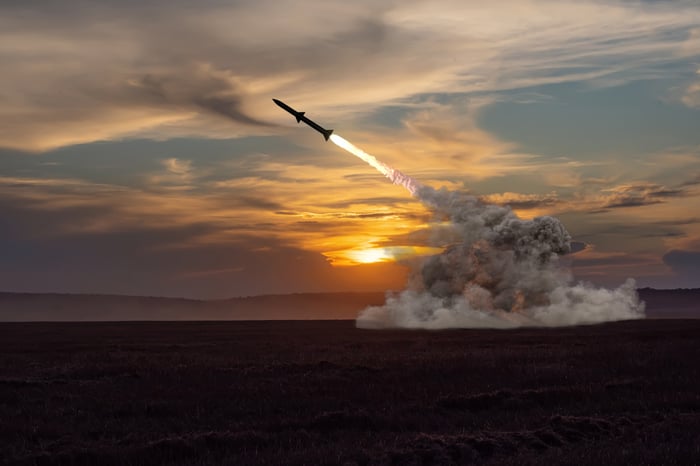
Image source: Getty Images.
Here’s what SpaceX needs to get right
SpaceX’s near-term business is centered on Starlink, while the S-1 also outlines ambitious plans to mine minerals on the moon and even colonize Mars. However, it seems that the main upside driver over the medium term, and where SpaceX needs to show progress, is in AI.
Fortunately, the S-1 outlines a differentiated AI strategy that, if executed, could enable SpaceX to gain a competitive advantage: data centers in space.
In the S-1, SpaceX says there are three ways to lower the cost per token for AI models: the underlying AI model, the price of computing chips, and the price of energy. While xAI has no doubt been competing on the first aspect, the model, putting AI data centers in space could give xAI a significant advantage in terms of the cost of energy. That’s because there is perpetual sunlight in space, meaning the data center can be powered with solar arrays at minimal cost. That compares with terrestrial data centers, which have to pay for utilities or on-site power.
On the chip front, SpaceX also has ambitions to build its own massive fab called Terafab, a joint venture with Tesla (NASDAQ: TSLA) in which both companies will design and manufacture their own chips. That should eliminate the massive margin paid to Nvidia (NASDAQ: NVDA) today and even cut out the big margins charged by Taiwan Semiconductor Manufacturing (NYSE: TSM) to the big cloud companies, which already design their own AI chips.
It will take a while for this to play out
It should be noted that sending data centers to space seems like an implausible idea today. It also usually takes several years for a semiconductor fab to go from conception to cranking out chips, meaning Terafab may not become a reality for years.
However, SpaceX has already achieved feats no other space company or government agency has managed, such as landing rockets on a launchpad and reusing them. So, one shouldn’t necessarily count Musk out.
Thus, this space-based AI data center idea is perhaps the main business strategy investors should monitor after SpaceX goes public. It could be the key to whether SpaceX is undervalued or overvalued today.
Where to invest $1,000 right now
When our analyst team has a stock tip, it can pay to listen. After all, Stock Advisor’s total average return is 986%* — a market-crushing outperformance compared to 208% for the S&P 500.
They just revealed what they believe are the 10 best stocks for investors to buy right now, available when you join Stock Advisor.
*Stock Advisor returns as of May 24, 2026.
Billy Duberstein and/or hsi clients have positions in Taiwan Semiconductor Manufacturing. The Motley Fool has positions in and recommends Nvidia, Taiwan Semiconductor Manufacturing, and Tesla. The Motley Fool has a disclosure policy.
5 Stocks Our Experts Predict Could Double In the Next Year
By submitting your email, you'll also get a free pivot & flow membership. A free daily market overview. You can unsubscribe at any time.