Key Points
-
SpaceX briefly topped Amazon’s market cap on June 16, reaching $2.97 trillion at its intraday peak.
-
The stock trades at 125 times trailing sales, roughly six times pricier than Nvidia.
-
SpaceX stock’s red-hot momentum may cool down considerably over the next couple of years.
- 10 stocks we like better than Space Exploration Technologies ›
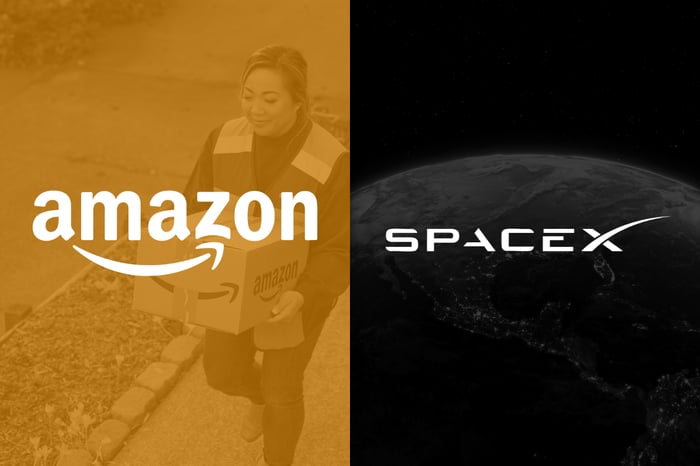
On June 16, Space Exploration Technologies (NASDAQ: SPCX), or SpaceX, soared to an intraday high of $225.29 per share. With 13.17 billion fully diluted shares outstanding, SpaceX was worth $2.97 trillion for a few minutes. Amazon (NASDAQ: AMZN) traded 10.6% below its own $2.96 trillion market cap peak that day.
The situation has reversed in the last couple of days, as Amazon caught a second wind and SpaceX started to sputter. As of this writing on June 18, Amazon is back on top with a $2.62 trillion cap versus the rocketry and AI company’s $2.36 trillion reading.
Where to invest $1,000 right now? Our analyst team just revealed what they believe are the 10 best stocks to buy right now, when you join Stock Advisor. See the stocks »
Still, SpaceX’s post-IPO momentum was an awe-inspiring moment, and the cap rankings might flip again. It’s getting crowded in the trillion-dollar club.
So SpaceX made big moves in its first week on Wall Street. Where might it go from here?
How SpaceX stacks up against the “Magnificent Seven”
Let’s compare and contrast SpaceX with the established “Magnificent Seven” stocks. Amazon, for instance, generated $723 billion in revenue over the last four quarters, while holding on to $90.8 billion in net income. The smallest Magnificent Seven business is SpaceX’s corporate cousin, Tesla (NASDAQ: TSLA), with trailing income of $3.9 billion on $98 billion in sales.
Over the same period, SpaceX posted a net loss of $8.69 billion on top-line revenues of $19.3 billion. These financials account for a full year of SpaceX rocket launches and Starlink operations, plus about two months’ worth of the xAI artificial intelligence company that merged into SpaceX at the end of February 2026. The X social media business followed along, having merged with xAI in February 2026.
It’s hard to tell exactly what each segment means to SpaceX’s overall business, since the company hasn’t reported quarterly earnings yet and its S-1 filing was light on segment-specific financials. Moreover, the fundamental rocketry operations are lumpy and unpredictable so far.
However, the xAI merger one month into Q1 2026 appears to have added more expenses than revenues. Building data centers isn’t cheap, and running AI operations in them is even more costly.
SpaceX makes Nvidia look cheap
Most stock data services don’t yet have any price-to-earnings (P/E) or price-to-sales (P/S) valuation ratios for SpaceX, and profit-based metrics don’t make sense while the company is burning cash by the billions. But the stock is trading at an orbital P/S ratio of 125x trailing revenue today. That may be thematically appropriate for a rocket-based company, but it’s also six times as expensive as Nvidia (NASDAQ: NVDA), the next-costliest Magnificent Seven stock at 20x trailing sales.
So SpaceX just elbowed past Amazon for a few glorious hours before reality reasserted itself. The stock’s lofty valuation makes Nvidia look downright frugal. Elon Musk has merged rockets, chatbots, and a social media platform into one publicly traded entity. Whether that’s brilliant vertical integration or a corporate turducken of epic proportions remains to be seen.
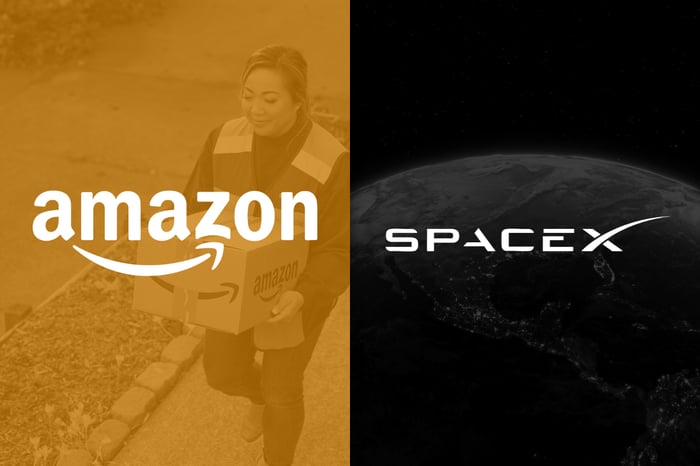
Image source: The Motley Fool.
Rockets, chatbots, and tweets under one roof (and I’m staying out)
The trillion-dollar club sure got a lot more interesting, adding a conglomerate of rocketry, social media, satellite-based internet, and AI businesses. The SpaceX headlines will write themselves for years to come.
But I don’t mind watching the struggle from Wall Street’s sidelines. I expect the red-hot stock to cool down considerably over the next couple of years.
Should you buy stock in Space Exploration Technologies right now?
Before you buy stock in Space Exploration Technologies, consider this:
The Motley Fool Stock Advisor analyst team just identified what they believe are the 10 best stocks for investors to buy now… and Space Exploration Technologies wasn’t one of them. The 10 stocks that made the cut could produce monster returns in the coming years.
Consider when Netflix made this list on December 17, 2004… if you invested $1,000 at the time of our recommendation, you’d have $417,305!* Or when Nvidia made this list on April 15, 2005… if you invested $1,000 at the time of our recommendation, you’d have $1,293,148!*
Now, it’s worth noting Stock Advisor’s total average return is 936% — a market-crushing outperformance compared to 209% for the S&P 500. Don’t miss the latest top 10 list, available with Stock Advisor, and join an investing community built by individual investors for individual investors.
*Stock Advisor returns as of June 20, 2026.
Anders Bylund has positions in Amazon and Nvidia. The Motley Fool has positions in and recommends Amazon, Nvidia, and Tesla. The Motley Fool has a disclosure policy.
5 Stocks Our Experts Predict Could Double In the Next Year
By submitting your email, you'll also get a free pivot & flow membership. A free daily market overview. You can unsubscribe at any time.