Every electric vehicle (EV) maker dreams of emulating the unparalleled success story that is Tesla. Since its IPO in 2010, Tesla has witnessed its shares surge by a mind-boggling 15,700%. In comparison, the S&P 500 saw a mere 600% increase over the same period.
Placing their bets on the Rivian Automotive (NASDAQ: RIVN) star to rise, enthusiastic investors aim to turn this dream into reality. And, indeed, there exist compelling reasons to support this optimistic outlook. Below, we delve into the three pivotal factors driving Rivian’s journey.
1. The Cash Conundrum
The EV space is a perilous domain, littered with the wrecks of past failures. Just last month, Fisker succumbed to bankruptcy, opting to liquidate its assets.
Even the titan Tesla danced dangerously close to insolvency before its metamorphosis into the industry juggernaut we witness today. In 2020, Elon Musk unveiled that the company teetered “about a month” away from financial ruin following production hitches with the Model 3 sedan.
The EV arena demands exorbitant capital outlays, akin to the traditional vehicle sector. Crafting cars and trucks necessitates billions in machinery investments alongside expansive teams for designing, testing, and marketing, all within an overly competitive, congested market. Without access to substantial funds, any entity attempting to manufacture vehicles is destined for a swift demise. Rivian seems to be the paradigm of financial robustness in this regard.
In 2019, financial behemoth Amazon spearheaded Rivian’s $700 million funding round. Come 2021, Rivian netted a $2.5 billion funding round, with Amazon and Ford as key participants. Recently, Rivian clinched a $1 billion investment from Volkswagen, a sum that could balloon to $5 billion through joint ventures and Rivian’s achievement of specific milestones.
While economic downturns pose a potential threat to Rivian’s capital access, the company’s cash reserves have dwindled from $11.2 billion to $7.9 billion in the last year. Nevertheless, Rivian appears primed to tackle the subsequent crucial phase: the launch of new vehicle models.
2. The Growth Imperative
Tesla’s revenue stood at approximately $7 billion in 2016, the year it debuted its first mass-market vehicle, the Model 3. Fast forward to the present day, and Tesla’s revenue hovers around $95 billion. The introduction of groundbreaking models like the Model 3 and Model Y significantly bolstered Tesla’s sales surge in recent times.
Leveraging ample capital access, Rivian eyes a replication of this sales upsurge. Earlier in the year, management unveiled plans to unleash a midsize category featuring three novel models: the R2, R3, and R3X. Priced around $45,000, the R2 will kick off the lineup, with the R3 slated for a subsequent release at an even more accessible price point. Although these models won’t hit the streets until 2026, Rivian’s corporate fortunes pivot on the commercial triumph of these vehicles.
Vigilance is paramount regarding potential manufacturing delays or pricing strategy shifts. Tesla weathered its own share of production tribulations on its growth trajectory, hence a seamless ramp-up may not be a foregone conclusion. To attain Tesla-esque greatness, Rivian must ace the market reception for the R2, followed by the R3 and R3X.
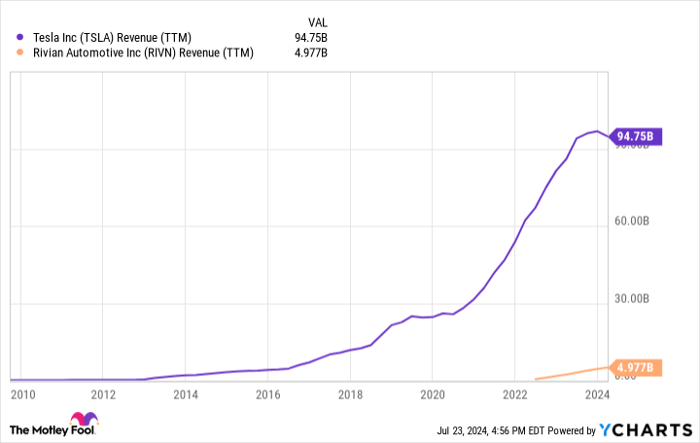
TSLA revenue (TTM); data by YCharts. TTM = trailing 12 months.
3. Profit Prophecies
Presently, Rivian incurs losses of around $39,000 for every vehicle sold. While this marks an improvement from the $67,000 loss per vehicle witnessed in the first quarter of 2023, market tolerance for these losses has an expiration date.
When Tesla first ventured into the public domain in 2010, it grappled with gross losses, a bout repeated briefly in 2012. However, for the most part, Tesla strung together an enviable streak of successive gross profits.
Rapidly closing this gap, Rivian seems to be laser-focused on profitability. Claire McDonough, the company’s CFO, expressed optimism earlier in the year, declaring, “We continue to move closer to making money on every vehicle we sell.”
The management team harbors hopes of achieving per-vehicle profitability as soon as the fourth quarter. While this remains a lofty goal, it stands as a pivotal milestone that Rivian must inevitably conquer.
Will Rivian seize the mantle of the next Tesla? The path ahead is strewn with challenges. Nonetheless, with many pieces of the puzzle in place, Rivian steels itself for this audacious pursuit. Monitoring the trio of variables outlined offers a real-time gauge of the company’s trajectory towards becoming the eminent EV brand of the future.
Should you invest $1,000 in Rivian Automotive right now?
Before diving into Rivian Automotive stock, contemplate this:
The Motley Fool Stock Advisor analysts have pinpointed what they consider the 10 best stocks for investors to snap up now—a list that regrettably excludes Rivian Automotive. These chosen 10 stocks harbor the potential to yield monumental returns in the years to come.
Recall Nvidia’s inclusion on this roster on April 15, 2005… Investing $1,000 at the recommendation juncture would have mushroomed into $688,005!
Stock Advisor furnishes investors with a simple yet effective roadmap to success, offering portfolio-building counsel, routine analyst updates, and bimonthly stock recommendations. The Stock Advisor service has outstripped the S&P 500’s returns by a staggering margin since 2002.
*Stock Advisor returns as of July 22, 2024
John Mackey, former CEO of Whole Foods Market, an Amazon subsidiary, sits on The Motley Fool’s board of directors. The Motley Fool has positions in and recommends Amazon, Tesla, and Volkswagen Ag. The Motley Fool upholds a disclosure policy.
5 Stocks Our Experts Predict Could Double In the Next Year
By submitting your email, you'll also get a free pivot & flow membership. A free daily market overview. You can unsubscribe at any time.