The whipping post

3 Tech Stocks With Overheated Prices


Unraveling the Rapid Ascent of Tech Stocks

The tech sector has been a clear winner for investors, spurred by the artificial intelligence (AI) trend, projecting immense wealth. Top tech stocks have been on an exhilarating run, propelling the market to new heights. Capturing this essence is the “Magnificent Seven,” collectively adding a jaw-dropping $5.1 trillion in market cap. The dominance of these giants significantly overshadowed the broader market index in 2023, a trend that appears to be even more pronounced this year.

Cautionary Tales in the Tech Industry

Yet, within this euphoria lies the danger of overvaluation. While some tech companies are beginning to translate AI potential into revenue, the rush of investor fervor can inflate certain stocks beyond their intrinsic value. The surge in share prices for some stocks has outpaced their underlying fundamentals, leaving new investors at considerable risk. Morgan Stanley, recognizing this precarious situation, has recently highlighted three tech stocks that might be best avoided due to their current valuations, proximity to price targets, or lack of immediate growth drivers.

Pure Storage: Riding High but Vulnerable

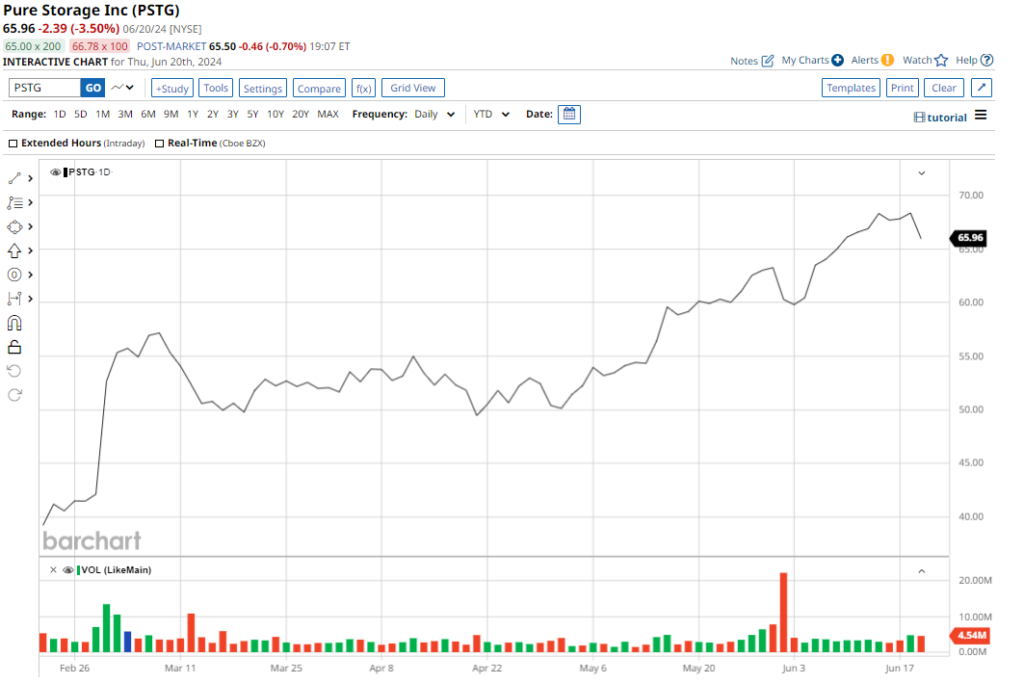
Launched in 2009 with a mission to revolutionize storage solutions, Pure Storage (PSTG) is a major player in the all-flash storage market. Their innovative “Evergreen Storage” model promises speed and cloud compatibility, reducing the need for frequent hardware upgrades. With a market cap of $21.4 billion, PSTG has surged 80.8% YTD in 2024.

www.barchart.com

Pure Storage exceeded expectations in Q1, with revenues up 18% to $693.5 million and an EPS of $0.32. However, trading at 41x forward earnings and 6.85x sales, the stock appears overvalued. Competition from tech giants and the threat of OEMs entering the market could challenge Pure Storage’s market position, urging a strategic focus on maintaining a competitive edge.

Morgan Stanley has downgraded PSTG to “Equal-weight”, citing limited near-term growth potential. Analysts maintain a “Moderate Buy” rating, with a mean target price of $68.95.

Corning: A Legacy Facing Headwinds

Corning (GLW), founded in 1851, boasts a rich history of material science innovation. Known for Gorilla Glass and optical fiber, the company faces a challenging landscape. With a market cap of $34.1 billion and a 31.5% YTD increase, Corning’s future is uncertain.

www.barchart.com

In Q1 2024, Core sales of $3.26 billion and an EPS of $0.38 indicated moderate performance. With cash balances shrinking and high debt levels, Corning faces challenges. Potential growth in AI data centers and environmental initiatives may offer avenues for recovery. Morgan Stanley lowered the stock to “Equal-weight,” with a revised target price of $38.

Analysts consider Corning a “Moderate Buy,” with a target price of $37.38.

See also  <!DOCTYPE html><html><head><title>Unraveling the Yen Carry Trade: A Financial Analysis</title></head><body><h2>The Rise and Fall of the Yen Carry Trade</h2><div><h3 class="wp-block-heading">Exploring the resurgence of the yen carry trade, its origins, unraveling, and the implications for the financial market</h3><p><em>Can the current market chaos be attributed to the unwinding of the yen carry trade despite the Fed's interventions to stabilize the economy?</em></p><p><em>Insights from notable economists shed light on this phenomenon, indicating potential risks and repercussions associated with carry trade unwinding.</em></p><p>Recent statements from financial experts underscore the severity of the situation, emphasizing the impact on risk assets in the context of global economic factors.</p><p>Reflecting on the market turmoil in August, we witnessed significant downturns in major indices, partly catalyzed by the unwinding of the yen carry trade.</p><p>The recent resurgence of discussions surrounding this trade prompts a deeper analysis to comprehend the events of August and anticipate possible future repercussions.</p><p>Our objective remains to discern market risks accurately, avoiding premature bear market assumptions and hasty portfolio exits driven by temporary anomalies like the yen carry trade.</p><h4 class="wp-block-heading">Demystifying the Mechanics of the Yen Carry Trade and its August Disruption</h4><p>Arguably one of the most widely embraced trades in modern finance, the yen carry trade found its allure in arbitrage opportunities.</p><p>Participants would borrow funds in yen, benefiting from near-zero borrowing costs, and channel these funds into high-yielding assets internationally, notably the U.S. stock market.</p><p>The core principle was simple: secure substantial returns from the investment, repay the yen loan at a minimal cost, and retain the profit margin.</p><p>By examining the Bank of Japan's historical short-term interest rates, which have been close to zero since 2000, the attractiveness of the yen carry trade becomes evident.</p><p>This trade garnered global interest, with investors worldwide capitalizing on the opportunity to borrow inexpensively in yen and invest in lucrative U.S. equities.</p><p>Assessing the magnitude of the yen carry trade proves challenging, with analyst estimates diverging widely between $1 trillion and $4 trillion. Nevertheless, the overarching narrative highlights substantial capital involvement in this trade.</p><h4 class="wp-block-heading">Unraveling the Lucrativeness of the Yen Carry Trade</h4><p>Recalling the historic Japanese market bubble of the late 1980s serves as a vivid precursor to the yen carry trade's attractiveness.</p><p>The exponential growth of the Nikkei 225 index during that period, coupled with exorbitant price-to-earnings ratios of prominent Japanese stocks, exemplified the speculative fervor and subsequent fallout.</p><p>The burst of this bubble plunged Japan into a prolonged period of deflation and economic stagnation, prompting the Bank of Japan to adopt 0% interest rates as a stimulus measure.</p><p>This environment, characterized by negligible inflation and depressed yields, laid fertile ground for the emergence of a robust and enduring yen carry trade, drawing widespread participation from global investors.</p><p>Fast-forwarding to recent years, the yen carry trade faced new challenges as Japanese inflation exhibited signs of life, prompting the Bank of Japan to take corrective measures.</p><h4 class="wp-block-heading">Echoes of Change: Japanese Inflation, BOJ's Response, and the Yen Carry Trade's Vulnerabilities</h4><p>Following decades of minimal inflation, Japan experienced a shift post-pandemic, with supply chain disruptions driving up commodity prices worldwide.</p><p>The geopolitical upheaval intensified as energy costs surged post-Russia's actions, impacting Japan as a major energy importer. Concurrently, the yen's depreciation against the dollar further escalated costs.</p><p>In response, the Bank of Japan intervened, triggering a significant appreciation in the yen's value to combat its prolonged depreciation.</p><p>The subsequent interest rate hike by the Bank of Japan signified a significant policy shift, increasing rates to approximately 0.25% from a decade-long range of 0% to 0.1% and outlining plans to curtail bond purchases.</p><p>This hike, marking the highest rates since 2008, has reverberated through the yen carry trade, fundamentally altering its cost dynamics.</p><p>Visualizing the yen's dollar valuation over the past year accentuates the impact of the BOJ's actions, underscoring the escalating costs associated with the yen carry trade.</p><p>One may interpret this trajectory as "the systemic repercussions of the yen carry trade coming to fruition."</p><div id="3190009" class="wp-caption aligncenter"></div></div></body></html><!DOCTYPE html><html><head> <title>The Unwinding Yen Trade and Market Dynamics</title></head><body> <img src="https://investorplace.com/wp-content/uploads/2024/09/yen-to-dollar-9.10.24.png" decoding="async" width="975" height="650" alt="the yen priced in dollars over the last year. The vertical spike I've circled is the effect of the BOJ's actions." class="aligncenter wp-image-3190009" srcset="https://investorplace.com/wp-content/uploads/2024/09/yen-to-dollar-9.10.24.png 975w, https://investorplace.com/wp-content/uploads/2024/09/yen-to-dollar-9.10.24-300x200.png 300w, https://investorplace.com/wp-content/uploads/2024/09/yen-to-dollar-9.10.24-768x512.png 768w, https://investorplace.com/wp-content/uploads/2024/09/yen-to-dollar-9.10.24-200x133.png 200w, https://investorplace.com/wp-content/uploads/2024/09/yen-to-dollar-9.10.24-400x267.png 400w, https://investorplace.com/wp-content/uploads/2024/09/yen-to-dollar-9.10.24-116x77.png 116w, https://investorplace.com/wp-content/uploads/2024/09/yen-to-dollar-9.10.24-100x67.png 100w, https://investorplace.com/wp-content/uploads/2024/09/yen-to-dollar-9.10.24-188x125.png 188w, https://investorplace.com/wp-content/uploads/2024/09/yen-to-dollar-9.10.24-75x50.png 75w, https://investorplace.com/wp-content/uploads/2024/09/yen-to-dollar-9.10.24-78x52.png 78w" sizes="(max-width: 975px) 100vw, 975px"> <p>Source: StockCharts.com</p> The Unwinding Yen Trade and Market Dynamics


Insightful Analysis on Twilio’s Financial Landscape

Insightful Analysis on Twilio’s Financial Landscape

Revolutionizing Communication: Twilio’s Unique Position

Twilio, founded in 2008, has etched its name as a cloud communications platform that arms software developers with APIs for seamless integration of voice, video, messaging, and authentication functionalities. Its prowess enables businesses to adorn their products with communication features sans the need to construct the underlying infrastructure. At a market cap of $9.15 billion, Twilio stands tall as a frontrunner in the realm of cloud communications.

Financial Performance and Market Volatility

Although TWLO stock has witnessed a YTD decline of 27.8%, the Q1 2024 results painted a different picture. With revenues surging by 4% to $1.05 billion and an impressive 70.2% rise in EPS to $0.80, Twilio outperformed expectations. The quarter saw an uptick in active customer accounts to 313,000, showcasing the company’s ability to attract and retain clients despite market fluctuations.

Challenges and Investor Sentiment

Amidst the positive financial report, concerns loom over Twilio’s Q2 revenue guidance falling short of estimates at $1.06 billion. Analysts fear the impact of persistent customer turnover within the Segment business could impede Twilio’s growth trajectory. Noteworthy is Cathie Wood’s recent exit from the stock, leaving investors speculating on the future course for Twilio. Morgan Stanley’s downgrade of TWLO stock further emphasized the challenges ahead, highlighting a lack of top-line catalysts in the coming year.

Unraveling the Long-Term Narrative

Beneath the surface, Twilio’s “long-term story” unveils its AI capabilities, with generative AI seamlessly integrated across its platform. The launch of CustomerAI, a predictive analytics suite embraced by 150+ customers, underscores Twilio’s commitment to innovation. Leveraging partnerships with tech giants like Google and collaborations with OpenAI for GPT-4 integration symbolize Twilio’s quest to enhance its AI offerings for a vast client base. With over 10 million developers tapping into its customer engagement platform globally, Twilio stands tall as a leading CPaaS player.

Market Outlook and Analyst Projections

Analysts resonate a “Moderate Buy” sentiment for TWLO stock, with a mean target price of $69.08, signaling a potential 26.2% upside from current levels. Among 29 analysts in coverage, 10 rate it as a “Strong Buy,” while 16 maintain a “Hold” rating. The outlook, although mixed, hints at a promising trajectory for Twilio amidst the dynamic market environment.


5 Stocks Our Experts Predict Could Double In the Next Year

By submitting your email, you'll also get a free pivot & flow membership. A free daily market overview. You can unsubscribe at any time.