Warren Buffett’s investment philosophy, steeped in value and prudence, continues to serve as a beacon for investors seeking to navigate the tumultuous seas of market volatility. As equity markets waver during the current earnings season, investors are turning to Buffett’s sage advice, advocating for index fund investments, particularly those mirroring the S&P 500 Index, as a shield against the storm of market gyrations that can buffet individual equities, even stalwarts like Nvidia (NVDA).
Exploring the S&P 500
Buffett often extols the virtues of the S&P 500 as a foundational investment choice due to its simplicity and inherent diversification. Despite the increasing dominance of large-cap tech companies within the index, Berkshire Hathaway (BRK.B) maintains its position among the top 10 holdings, underscoring the enduring influence of traditional sectors like finance. At a colossal value of $930 billion, Berkshire’s presence underscores the sizable bet inherent in an S&P 500 investment.
Delving into the composition by S&P sector, the market-weighted S&P 500 consists of approximately 31% in technology, spearheaded by industry behemoths like Apple (AAPL), Microsoft (MSFT), and, notably, Nvidia. This is followed by financials at 13%, healthcare at 11.9%, with Eli Lilly (LLY) leading the healthcare cohort. The consumer discretionary sector, home to Tesla (TSLA) and Amazon (AMZN), accounts for 10% of the index, while communication services, represented by Alphabet (GOOGL), Meta (META), Disney (DIS), and telecom giants, confer an 8.9% presence.
Focusing on Buffett, Berkshire, and the S&P Dynamics
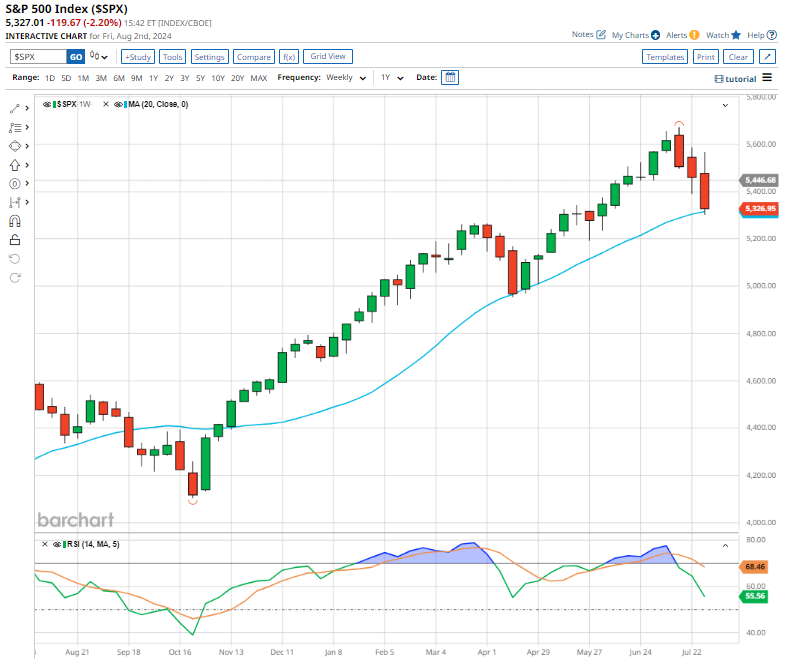
As anticipation builds around Warren Buffett’s looming presence ahead of Berkshire’s earnings release, investors await cues on the continuation of his recent divestments and cash accumulation strategies. Against the backdrop of Friday’s SPX decline amidst economic uncertainties, technical indicators hint at a potential rebound akin to April’s trendline bounce.

For investors aspiring to emulate Warren’s revered S&P 500 strategy, two prominent exchange-traded funds (ETFs) feature prominently in Berkshire’s portfolio.
The SPDR S&P 500 ETF Trust (SPY) and the Vanguard S&P 500 ETF (VOO) have emerged as leading options in the ETF landscape, facilitating investors in executing Buffett’s timeless buy-and-hold precept. Here’s a comparative analysis for the discerning Buffett acolytes.
SPDR S&P 500 ETF (SPY)
The SPDR S&P 500 ETF Trust (SPY) stands as a cornerstone in the ETF domain. Inaugurated in 1993, SPY was the pioneer ETF to hit U.S. markets, evolving into a preferred choice for investors seeking expansive exposure to U.S. large-cap equities.
Designed to mirror the S&P 500 Index, SPY offers investment outcomes aligned with the index’s performance, employing a passive strategy ideal for those eyeing exposure to the U.S.’s premier 500 companies without active management interventions.
SPY’s immense popularity hinges on its size and liquidity. Managing a staggering $549.6 billion in assets, SPY ranks among the largest ETFs globally, translating to robust liquidity with an average trading volume exceeding 51 million shares. This ample liquidity ensures seamless trading without concerns of slippage, rendering SPY an alluring avenue for both long-term investors and active traders.
Boasting an active options market, SPY offers a natural avenue for price speculation or safeguarding against market downturns.
In the performance realm, SPY has surged by 11.87% in 2024, aligning closely with its underlying benchmark. Moreover, SPY disburses quarterly dividends, presently yielding 1.26% annually.
Delivering on its investment approach, boasting heightened liquidity and an active market, and offering diverse equity exposure spanning multiple sectors, SPY emerges as the preferred choice for Buffett investors. However, with an expense ratio of 0.09%, SPY might not be the most cost-effective option among the S&P 500 ETF roster.
Vanguard S&P 500 ETF (VOO)
Enter the Vanguard S&P 500 ETF (VOO), another prominent player in the ETF landscape. Launched in 2010, VOO has swiftly ascended as a favored option for investors seeking comprehensive exposure to U.S. large-cap equities.
Similar to SPY, VOO mirrors the S&P 500 Index’s performance, upholding a passively driven strategy that has yielded favorable returns. Currently, VOO posted a YTD upswing of just over 12%.

Additionally, VOO offers quarterly dividends, with the latest payout of $1.78 per share translating to a dividend yield of 1.33%.
Currently managing $482.13 billion, with an average trading volume of approximately 5.8 million shares, VOO delivers an adequate level of liquidity for investors to engage in seamless trading activities. While VOO supports options, the daily trading volume typically hovers below 5,000 contracts.
Amidst stiff competition, VOO’s allure lies in its cost-efficiency. Sporting an expense ratio of merely 0.03%, it stands as one of the most economical S&P 500 tracking avenues. This competitive fee structure empowers long-term investors to retain more of their returns over time, positioning VOO attractively for cost-conscious individuals.
Summarizing Buffett’s ETF Selections
Both SPY and VOO emerge as stellar options for investors looking to align with Warren Buffett’s investment principles. Each ETF offers broad, diversified exposure to the U.S. large-cap market, catering to individuals seeking a “set it and forget it” strategy for enduring investments.
5 Stocks Our Experts Predict Could Double In the Next Year
By submitting your email, you'll also get a free pivot & flow membership. A free daily market overview. You can unsubscribe at any time.