
A specialist in battery manufacturing for Apple’s iconic iPhones, Japan’s TDK Corporation (TTDKY) announced a groundbreaking achievement in solid-state battery chemistry, positioning itself at the frontier of innovation.
Founded in 1935, TDK originated as a provider of ferrite cores, a key component enhancing radio and television reception, later advancing to cassette tape recording technology. Currently, the company’s influence extends widely, dominating the market for small-capacity batteries fueling smartphones and edging into strategic sectors like car sensors and power storage.
A long-standing player in battery materials and technology, TDK presently commands a substantial 50% to 60% share of the global small-capacity battery market. Now setting its sights on the medium-capacity domain, encompassing energy reservoirs and larger electronics such as drones, TDK is poised to bring sizeable disruptions to the tech landscape.
The Paradigm Shift: TDK’s Innovative Stride
Signaling a transformative leap in energy storage technology, TDK unveiled a remarkable discovery: a novel material yielding an energy density of 1,000 watt-hours per liter (Wh/l). This surpasses competitors’ solid-state batteries, offering a promising advantage in performance. TDK’s envisioned batteries, constructed from an all-ceramic compound with oxide-based solid electrolytes and lithium alloy anodes, herald a new era of compact yet robust power sources.
By enabling enhanced charge retention in a condensed form factor, these batteries are engineered to replace conventional coin-shaped cells in various gadgets, promising extended runtimes and compact designs.
Set to initiate sample distributions to clients next year, TDK anticipates transitioning to mass production shortly thereafter, potentially extending device battery life from days to weeks.
Challenges on the Horizon
Despite TDK’s groundbreaking strides, challenges loom on the path to commercialization. Scaling up these batteries for applications in electric vehicles and smartphones presents formidable engineering obstacles.
While solid-state batteries exhibit superior safety, weight, and durability characteristics compared to liquid-electrolyte variants, TDK’s ceramic-based composition amplifies fragility concerns in larger-scale deployments. Consequently, achieving the scalability required for automotive and mobile applications may remain a prolonged endeavor.
While the journey towards solid-state battery’s integration into EVs may be protracted, TDK, along with Japanese counterpart Toyota Motor (TM), sets the stage for forthcoming innovations. Toyota’s announcement regarding its solid-state battery’s potential to achieve an impressive 750-mile range on a single charge hints at the sector’s promising evolution.
Diversification and Growth: TDK’s Strategic Blueprints
Beyond its groundbreaking battery technology, TDK steers multiple high-growth ventures, catering to burgeoning demands in the AI and semiconductor industries. As the appetite for AI-centric devices surges, TDK leverages its expertise to furnish energy-efficient solutions and compact chipsets, instigating collaborations with leading semiconductor players like Nvidia.
In tandem with its AI synergies, TDK eyes expansion in existing sectors such as capacitors and sensors for automotive giants like Tesla. Furthermore, their foray into medium-sized batteries to power drones underscores a multifaceted growth strategy.
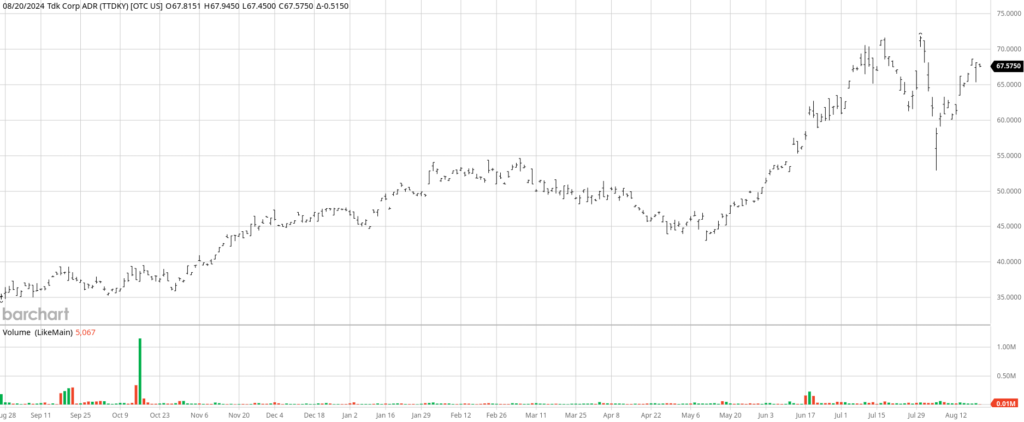
Bolstered by a robust financial performance, highlighted by a 42% year-to-date stock price surge and 95% annual growth, TDK continues to fortify its mantle as a key player in the technology realm.

5 Stocks Our Experts Predict Could Double In the Next Year
By submitting your email, you'll also get a free pivot & flow membership. A free daily market overview. You can unsubscribe at any time.