Key Points
-
Broadcom’s AI semiconductor revenue more than doubled year over year in its most recent quarter.
-
Taiwan Semiconductor’s high-performance computing platform now accounts for more than 60% of total revenue.
-
Both stocks have been winners, but one’s growth profile and visibility look more compelling.
- 10 stocks we like better than Broadcom ›
When it comes to investing in the AI (artificial intelligence) build-out from the chip side, two names stand out right now as particularly interesting investment ideas: AI chip designer Broadcom (NASDAQ: AVGO) and contract chipmaker Taiwan Semiconductor (NYSE: TSM). Broadcom designs the custom silicon and networking chips that hyperscalers like Alphabet, Meta Platforms, and Anthropic depend on for their growing AI infrastructure. And Taiwan Semiconductor manufactures most of the world’s advanced chips — including the ones Broadcom, Nvidia, and AMD design but cannot build themselves.
Both stocks have been big winners over the past year, and both businesses delivered standout results recently. But there are some real differences when it comes to how directly each company’s growth is tied to AI and how much visibility each one has into the next few years.
Will AI create the world’s first trillionaire? Our team just released a report on the one little-known company, called an “Indispensable Monopoly” providing the critical technology Nvidia and Intel both need. Continue »
So, which of the two stocks is the better buy today?
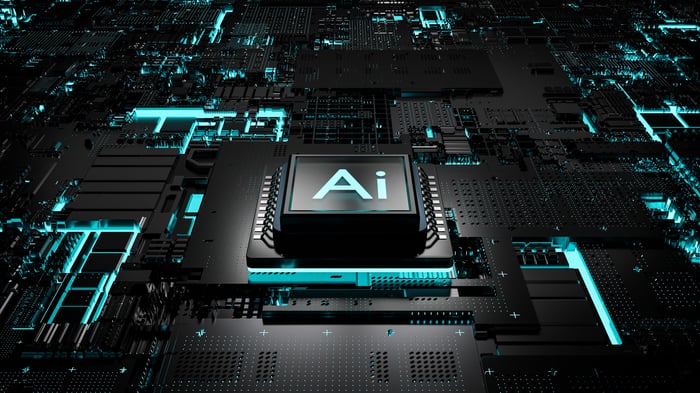
Image source: Getty Images.
Broadcom: AI growth keeps accelerating
In its fiscal first quarter of 2026 (the period ended Feb. 1, 2026), Broadcom posted revenue of $19.3 billion, up 29% year over year. But the headline metric was AI semiconductor revenue, which rose 106% year over year to $8.4 billion. That pace marked a notable acceleration from 74% growth in the prior quarter.
Looking ahead, the chipmaker guided for fiscal second-quarter revenue of about $22 billion — up 47% year over year, with AI semiconductor revenue of roughly $10.7 billion.
But what may matter most for the long-term story came on the company’s fiscal first-quarterearnings call where CEO Hock Tan laid out the chipmaker’s longer-term AI ambition.
“Today, in fact, we have line of sight to achieve AI revenue from chips, just chips, in excess of $100 billion in 2027,” Tan said. “We have also secured the supply chain required to achieve this.”
That visibility is backed by an AI-related backlog of about $73 billion and a roster of six major customers, including Alphabet’s Google, Meta, Anthropic, and OpenAI.
Beneath this growth is a cash machine. Broadcom generated $8 billion of free cash flow in fiscal Q1 (about 41% of revenue) and returned $10.9 billion to shareholders. The board also authorized a new $10 billion share repurchase program.
Taiwan Semiconductor: a foundry juggernaut
Taiwan Semiconductor’s first-quarter 2026 results showed similar AI-driven momentum, just in a more diversified form. Revenue rose 40.6% year over year in U.S. dollar terms to $35.9 billion. The company’s high-performance computing platform, which includes AI accelerators and data center processors, grew 20% sequentially to account for 61% of total revenue, up from 55% in the prior quarter. Smartphone-related sales, by contrast, fell 11% sequentially.
Profitability was the other highlight. Gross margin expanded to 66.2%, well above the high end of the company’s prior guidance. And operating margin reached an impressive 58.1%.
Looking ahead, management raised its full-year 2026 revenue growth forecast to more than 30% in U.S. dollar terms.
Additionally, at a technology symposium this week, TSMC also said it expects the global semiconductor market to exceed $1.5 trillion by 2030, with AI and high-performance computing accounting for 55% of that market.
“AI-related demand continues to be extremely robust,” CEO C.C. Wei said during the company’s first-quarterearnings call
April’s monthly revenue figure, however, showed some cooling. Sales for the month rose 17.5% year over year — a step down from the first quarter’s pace, in part reflecting tougher year-over-year comparisons. Still, revenue through the first four months of the year was up about 30% from the same period last year, keeping the full-year outlook within reach.
The better buy
Both companies are AI winners. But Broadcom arguably comes out on top when considering the two companies as potential investment opportunities.
The case comes down to growth concentration and visibility. Broadcom’s revenue growth is more directly fueled by AI today, with AI semiconductor sales more than doubling year over year and accelerating each quarter recently. Meanwhile, Taiwan Semiconductor’s growth is strong but spread across more end-markets, leaving its trajectory more exposed to swings in non-AI areas like smartphones.
That said, valuation is the obvious mark against Broadcom. The stock trades at a price-to-earnings ratio in the 80s — more than double Taiwan Semiconductor’s roughly 36. But on a forward basis — using consensus forecasts for earnings over the next 12 months — Broadcom trades around 39 times these earnings estimates, much closer to Taiwan Semiconductor’s forward multiple of around 26.
One risk is that Broadcom’s AI revenue is concentrated in a handful of hyperscaler customers. And for Taiwan Semiconductor, there’s the risk of its direct geopolitical exposure stemming from the concentration of its most advanced fabs in Taiwan.
Overall, however, I prefer Broadcom. Its accelerating AI growth, paired with a $73 billion backlog and a publicly stated $100 billion AI chip revenue target for 2027, arguably makes it the more compelling buy today.
Should you buy stock in Broadcom right now?
Before you buy stock in Broadcom, consider this:
The Motley Fool Stock Advisor analyst team just identified what they believe are the 10 best stocks for investors to buy now… and Broadcom wasn’t one of them. The 10 stocks that made the cut could produce monster returns in the coming years.
Consider when Netflix made this list on December 17, 2004… if you invested $1,000 at the time of our recommendation, you’d have $472,205!* Or when Nvidia made this list on April 15, 2005… if you invested $1,000 at the time of our recommendation, you’d have $1,384,459!*
Now, it’s worth noting Stock Advisor’s total average return is 999% — a market-crushing outperformance compared to 208% for the S&P 500. Don’t miss the latest top 10 list, available with Stock Advisor, and join an investing community built by individual investors for individual investors.
*Stock Advisor returns as of May 14, 2026.
Daniel Sparks and his clients have no position in any of the stocks mentioned. The Motley Fool has positions in and recommends Advanced Micro Devices, Alphabet, Broadcom, Meta Platforms, Nvidia, and Taiwan Semiconductor Manufacturing. The Motley Fool has a disclosure policy.
5 Stocks Our Experts Predict Could Double In the Next Year
By submitting your email, you'll also get a free pivot & flow membership. A free daily market overview. You can unsubscribe at any time.