
Key Points
Everyone’s talking about SpaceX’s initial public offering (IPO), which makes a lot of sense given that it’s led by Elon Musk and features exciting new technology.
But good investing is more than flashy CEOs and new frontiers. Here’s why I think investors should avoid the SpaceX IPO, and what you might want to buy instead.
Will AI create the world’s first trillionaire? Our team just released a report on the one little-known company, called an “Indispensable Monopoly” providing the critical technology Nvidia and Intel both need. Continue »
Common stock and common sense
According to Bloomberg’s original IPO report, SpaceX is eyeing a $1.75 trillion valuation when it goes public, and the IPO aims to raise $75 billion. That’s quite a valuation, and it would make the company the eighth most valuable company in the world, right behind Broadcom (NASDAQ: AVGO), and ahead of Musk’s other company, Tesla (NASDAQ: TSLA). The filing with the Securities and Exchange Commission was made confidentially, so investors don’t have access to the financials, but SpaceX would have to make a lot of money for the valuation to make sense.

Image source: Getty Images.
SpaceX is more than theoretical space travel. It already puts satellites and rockets into space and brings people up, too, and Musk has said that he’s looking to bring people to Mars. It counts the U.S. Defense Department and NASA as customers, and it’s the largest private space company in the United States.
SpaceX merged with Musk’s artificial intelligence (AI) company, xAI, in February, and the company’s Starlink satellite broadband product provides internet services to millions of customers globally. According to Bloomberg, the rocket launcher and Starlink businesses will generate about $20 billion in revenue in 2026, with xAI making around $1 billion. According to Reuters, it made $15 billion to $16 billion in revenue last year, with $8 billion in profit.
Even using the larger number of $20 billion, a $1.75 trillion market cap implies a price-to-sales ratio of 87, which is astronomical, pun intended. There’s already a ton of growth baked into that valuation. These kinds of hyped-up IPOs often surge at first and then fall, leaving retail investors holding the bag.
Other ways to play the trend
If you’re interested in investing in space exploration, a safer way to do it is to invest in a space-themed exchange-traded fund (ETF), such as the Ark Space and Defense Innovation ETF (NYSEMKT: ARKX), the Invesco Aerospace & Defense ETF (NYSEMKT: PPA), and the State Street SPDR S&P Aerospace & Defense ETF (NYSEMKT: XAR). All of these ETFs have holdings in companies related to space exploration, and they’re all outperforming the S&P 500.
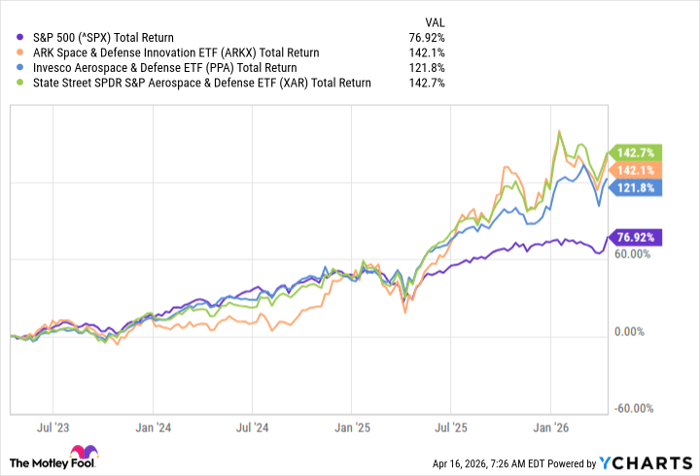
You can buy the Ark ETF for only $33, and all of these ETFs are easily tradable on open markets. They give you exposure to many different space and defense stocks, but the risk is minimized by the diversification and more established holdings. For example, the Invesco ETF’s top holdings are Boeing and General Electric, but it also owns shares of Rocket Lab and Planet Labs. If you have a greater appetite for risk, the Ark ETF’s top holdings include Rocket Lab and Archer Aviation.
It’s also possible that once SpaceX does go public, some of these ETFs could take a position, giving you access to the stock while lowering your risk.
Should you buy stock in Ark ETF Trust – Ark Space & Defense Innovation ETF right now?
Before you buy stock in Ark ETF Trust – Ark Space & Defense Innovation ETF, consider this:
The Motley Fool Stock Advisor analyst team just identified what they believe are the 10 best stocks for investors to buy now… and Ark ETF Trust – Ark Space & Defense Innovation ETF wasn’t one of them. The 10 stocks that made the cut could produce monster returns in the coming years.
Consider when Netflix made this list on December 17, 2004… if you invested $1,000 at the time of our recommendation, you’d have $524,786!* Or when Nvidia made this list on April 15, 2005… if you invested $1,000 at the time of our recommendation, you’d have $1,236,406!*
Now, it’s worth noting Stock Advisor’s total average return is 994% — a market-crushing outperformance compared to 199% for the S&P 500. Don’t miss the latest top 10 list, available with Stock Advisor, and join an investing community built by individual investors for individual investors.
*Stock Advisor returns as of April 18, 2026.
Jennifer Saibil has no position in any of the stocks mentioned. The Motley Fool has positions in and recommends Boeing, Broadcom, GE Aerospace, Planet Labs, Rocket Lab, and Tesla. The Motley Fool has a disclosure policy.
5 Stocks Our Experts Predict Could Double In the Next Year
By submitting your email, you'll also get a free pivot & flow membership. A free daily market overview. You can unsubscribe at any time.