
Consumer sentiment for electric vehicles (EVs) has mellowed due to high prices and concerns over charging infrastructure, leading to a surge in the popularity of hybrids – vehicles that combine gasoline and electric power. Recent years have witnessed robust growth in hybrid sales, outpacing the adoption of pure electric vehicles in the U.S. market.
As the U.S. government under the Biden administration tightens auto emissions regulations to curb carbon footprints, manufacturers of plug-in hybrids and traditional gas-electric hybrids are poised for growth.
With the U.S. hybrid EV market projected to expand significantly at a CAGR of 13.8% over the next decade, investors are eyeing two automotive behemoths – Ford Motor Company (F) and Toyota Motor Corporation (TM) – as they vie for a larger slice of the burgeoning hybrid EV market.
Let’s delve into an analysis of these two stocks to ascertain which could present a more promising investment opportunity.
Evaluating Ford Motor Stock
Ford Motor Company (F), a Michigan-based firm founded in 1903, specializes in the development, production, and servicing of a diverse range of vehicles, including trucks, SUVs, commercial vehicles, and luxury cars under the Lincoln brand. Currently boasting a market capitalization of $51.89 billion.
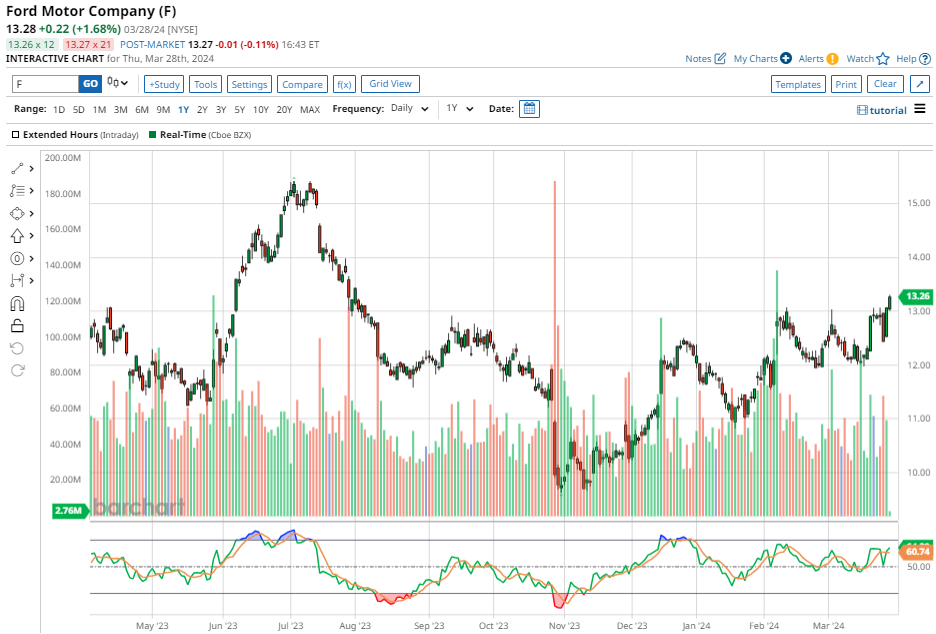
Over the past year, Ford’s shares have appreciated by 14.5%, falling short of the S&P 500 Index’s 30.5% growth. Ford stock has demonstrated a lackluster performance over the last decade, registering a decline of nearly 15%.
After halting dividend disbursements in the wake of the pandemic in 2020, Ford reinstated a quarterly dividend of 10 cents per share in October 2021. The company has incrementally raised its dividend payouts, culminating in a regular quarterly dividend of 15 cents per share announced during the Q4 2023 earnings call along with a special dividend of 18 cents per share.
Ford’s annual dividend of $0.60 per share equates to a yield of 4.6%. With a payout ratio of 61.4%, the company exhibits robust dividend coverage based on adjusted earnings.

Currently trading at 6.85 times forward adjusted earnings and 0.29 times sales, Ford’s valuation represents a significant discount compared to industry peers and its own historical averages.
Ford Exceeds Q4 Earnings Projections
In 2023, Ford sold 72,608 EVs, incurring an EBIT loss of $4.7 billion in its “Model e” segment. The company faced a substantial loss of $64,731 for each EV sold in the same period. Despite this, Ford witnessed a surge in total hybrid sales, with a record-breaking 55% increase in Q4 sales to 37,229 vehicles.
In the recent Q4 earnings report for early February, Ford reported a net loss of $526 million, primarily due to special charges related to employee pension plans and restructuring of overseas operations. The company’s CFO, John Lawler, attributed the Q4 profit decline to heightened labor expenses resulting from an extended strike by the United Automobile Workers (UAW) union.
Despite these challenges, Ford’s adjusted Q4 earnings of $0.29 surpassed analyst expectations, while its revenue of $43.21 billion exceeded Wall Street’s forecasts.
Toyota’s Hybrid Dominance in the EV Market
The Resilience of Toyota
Despite a fluctuating market sentiment towards Ford, the spotlight is shifting towards another auto giant, Toyota. Established in 1933, Toyota Motor Corporation boasts a market capitalization of $341.6 billion. The company has garnered global recognition for its design, manufacture, and sales of passenger vehicles and related accessories.
Historical Success and Future Prospects
Investors have witnessed Toyota shares take an impressive 82.5% leap over the past 52 weeks, significantly outpacing broader market indexes. This robust performance is not an anomaly; over the past decade, the stock has yielded a return of nearly 123%.
Dividend Consistency and Financial Stability
Toyota’s commitment to shareholders spans 37 years of consistent dividend payments. With an annualized dividend of $4.00 per share and a yield of 1.58%, the company exhibits financial stability and a focus on rewarding its investors.
The Hybrid Evolution
For decades, Toyota has been at the forefront of hybrid vehicle technology. The company’s recent fiscal Q3 report revealed a sales increase of 23% year-over-year, with a staggering 47% rise in hybrid vehicle sales. With this steady growth trajectory, Toyota is strategically positioned to capitalize on the burgeoning hybrid electric vehicle (EV) market.
Strategic Forecast and Market Positioning
Toyota’s visionary leadership is evident in its strategic forecasts. Chairman Akio Toyoda’s prediction regarding the saturation point of all-EVs at 30% of the global market underscores the company’s foresight. Executive Vice President Yoichi Miyazaki’s projection of 5 million hybrid car sales by 2025 highlights Toyota’s commitment to innovation and sustainability.
Comparative Investment Analysis
As investors weigh their options between Ford and Toyota, the scale tips in favor of the latter. While Ford may hold an edge in the EV segment, Toyota’s legacy of innovation and robust financial standing position it as a dominant force in the hybrid EV market. Coupled with a track record of reliable dividend payments, Toyota emerges as a more compelling investment opportunity.
5 Stocks Our Experts Predict Could Double In the Next Year
By submitting your email, you'll also get a free pivot & flow membership. A free daily market overview. You can unsubscribe at any time.