Let’s capitalize on analyst incompetence—and bank yields up to 18.3%, with upside to boot!
A widely cited academic study on analyst target price accuracy found that only about 54% of 12-month price targets correctly predicted even the direction of the subsequent price move.
Fifty-four percent. On direction alone. That’s barely better than a coin flip!
Analysts give specific price targets to stocks like they are scripture. In reality, they don’t even know if the thing is going to move up or down.
And it gets uglier. A 2024 Yale School of Management study found that analysts systematically delay downgrading stocks after bad news—to curry favor with the companies they cover. The suits aren’t just bad at predicting stock moves. They’re deliberately stalling their warnings to protect their banking relationships.
Put those two facts together and the picture is clear. Wall Street “research” is a farce. Which is exactly why it works so well as a contrarian indicator!
When Wall Street’s collective price target sits below the stock’s current price, that’s not a signal to sell. That’s a signal that full pessimism is baked in! All it takes is one decent earnings report and the stock gaps higher while the research machine scrambles to reload.
Today we’ll review five hated dividend payers with yields of 6.7% to 18.3% with the potential to rally when analysts change their tune.
Virtus Investment Partners (NYSE:)
Dividend Yield: 6.7%
Let’s start with Virtus Investment Partners (VRTS), an investment manager that provides mutual funds, exchange-traded funds (ETFs), closed-end funds (CEFs), insurance funds, separately managed accounts and more.
This is no Vanguard or Fidelity. Its $160 billion or so in assets under management (AUM) is a fraction of what the big boys handle, and most readers might not recognize the name.
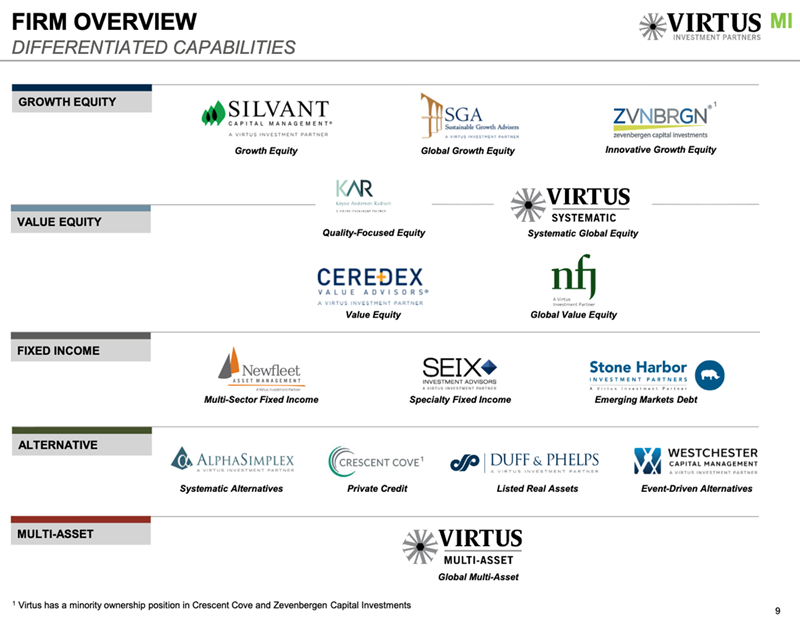
But Virtus still stands out because of its structure. It’s a partnership of numerous boutique investment advisers, which means different funds under the Virtus name are often managed by different groups.
Source: Virtus Investment Partners, March 2026 Investor Presentation
This company peaked in late 2021 amid the broader market’s roaring recovery. Since then, however, it has lost nearly 60% of its value, reflecting slowdowns on both the top and bottom lines. This year might not be any different, with the pros looking for single-digit declines in both revenues and profits.
Part of the issue has been weak performance in some of Virtus’ most important funds. But there’s also the overall nature of its products—Virtus is a predominantly actively managed (read: higher-fee) outfit in an age when most investors are looking for passive, low-fee ways to invest.
Wall Street’s not high on this stock as a result. A common thread among hated stocks is that they’re also poorly covered stocks—many analysts prefer to simply drop coverage of a company rather than irk management by telling people to sell. That’s the case with VRTS, which has just four covering analysts. One says it’s a Buy, one calls it a Hold, and the other two are Sells. For however tame that might sound, that’s an ugly split in the stock-research world.
Virtus does have a handful of contrarian appeals, though.
Shares trade for a paper-thin 5.5 times next year’s earnings estimates. The dividend has exploded by more than 400% over the past decade, and that includes a near-doubling over the past five years alone. That payout is safe, too, at less than 40% of next year’s earnings. And the company has made numerous acquisitions (such as Alphasimplex, AGI and Stone Harbor) in hopes of sparking longer-term growth.
Alexander’s (NYSE:)
Dividend Yield: 7.6%
Alexander’s (ALX) is a REIT that operates exclusively in the greater New York City metropolitan area. It’s technically classified as an office landlord, though its properties also include retail and residential space. Vornado Realty Trust (VNO), which predominantly operates in the Big Apple (but also owns one property in each of Chicago and San Francisco), owns a 32.4% stake and also manages the company, which means ALX owes it annual management fees and occasionally development fees.
The most important thing to know about Alexander’s is just how concentrated it is. ALX has just five properties under its umbrella—and it’s about to be four. In March, the company entered an agreement to sell its Rego Park I property to Northwell Health for $202 million in net proceeds.
So, in a nutshell:
- Alexander’s already-tiny real estate roster is somehow getting smaller.
- Despite its small portfolio, the company still has external management expenses.
- ALX earned $10.82 per share over the trailing 12 months and is expected to earn $12.08 per share across 2026, but it’s on pace to pay out almost 50% more than that ($18 per share) in dividends.
- Shares trade around 19 times next year’s AFFO estimates.
- The stock is down to one lone analyst who says we should Sell.
No Greatness From Alexander’s Since Its Last Dividend Hike in 2018

I pointed out Alexander’s loathed status on Wall Street back in November. Since then, it has put together a 15% gain, but it has done so by fattening an already hefty valuation.
If ALX continues to rise from here, it will be defying gravity—and sanity.
Conagra Brands (NYSE:)
Dividend Yield: 10.0%
Companies selling pantry and household basics are not popular right now. I recently highlighted how sector-wide pain had driven up consumer staples yields, but it’s not just shareholders who are selling—analysts think we should unload those stocks, too. Wall Street’s most-hated list includes a ton of sector names, including Kraft Heinz Co (NASDAQ:), Campbell’s Soup (NASDAQ:) and General Mills (NYSE:), the last of which I identified as a prime GLP-1 victim.
But the worst-rated of the group right now is Conagra Brands (CAG), which has gone from a reasonably high yielder to a sky-high payday for the wrong reason: a multiyear cratering in shares.
CAG Is Paying 2x Its Historical Dividend Ceiling

Conagra owns a broad portfolio of packaged food brands, including Banquet, Healthy Choice, Marie Callender’s, Vlasic, Duncan Hines, Slim Jim, Reddi-Wip, and more. It also has a foodservice business that offers more diversification than most grocery-anchored staples names.
But it has been taking blows from all sides: GLP-1 adoption. Soaring input costs. Cuts to SNAP. Encroachment by private-label brands. Its top and bottom lines have been contracting, and the pros expect more of the same over the next couple years.
Understandably, the pros don’t love it. A dozen analysts covering Conagra say investors should stay on the sidelines; two call it a Buy, and four say it’s a Sell. Consider this a “bearish Hold”; analysts overcorrect toward being bullish, which means even Holds have a negative connotation, making this a very bearish consensus.
The dividend is in doubt. The payout represents about 80% of next year’s (lower) earnings estimates, which by itself doesn’t signal an immediate threat—plenty of defensive companies can manage at that level. However, 1.) it doesn’t give CAG much room to explore M&A to reposition its portfolio, and 2.) that’s well above Conagra’s stated target ratio range of 50% to 55%.
Western Union Co (NYSE:)
Dividend Yield: 10.5%
Western Union (WU) was founded as a telegraph service, and its core business today is money transfers in an age of PayPal and Venmo.
It seems like such a dead company from 10,000 feet that Wall Street’s view—it has 10 Holds, just 1 Buy, and six Sells on the stock—almost seems too optimistic.
But credit where credit is due: Western Union has been scrapping hard to remain relevant.
Its “Evolve 2025” initiative is standard corporate fare: new products and improvements, as well as operational efficiencies.
However, in April 2025, it spent $77 million on foreign-exchange specialist Eurochange to further expand its “Travel Money” unit.
It made a bigger splash that summer with a $500 million acquisition of Miami-based International Money Express (IMXI), aka Intermex, which serves some 6 million customers who send money from the United States, Canada, Spain, Italy, the United Kingdom, and Germany to more than 60 countries. (The deal is expected to close in mid-2026.)
WU has also begun to lean heavily into digital assets. It very recently launched its own “USDPT” stablecoin alongside its Digital Asset Network, the latter of which will help people with partnered cryptocurrency wallets cash out across Western Union’s network of 380,000 agents. A Visa-branded prepaid USD “stable card” is expected to launch later this year, will let consumers hold value in Western Union’s USDPT and spend it globally.
The question is whether all of this will help counter the secular decline of its cash-based money-transfer business. One promising sign? Revenues are expected to improve by mid-single-digits this year and next, and while profits are expected to remain virtually flat for the fourth straight year, the pros now see a 10% bump in the bottom line for 2027.
Can Western Union Finally Stop the Long Bleed?

Prospect Capital (NASDAQ:)
Dividend Yield: 18.3%
Prospect Capital (PSEC) has a lot of headline stats that are hard to ignore. It pays more than 18% right now. It’s a monthly dividend stock, to boot. And it trades at a wild 60% discount to its net asset value (NAV), making it one of the cheapest business development companies (BDCs) on the market.
On the other hand …
4 Dividend Cuts and Barely Breakeven Returns in 12 Years

It was already a miserable history to overcome, and it got even worse of late, with Prospect Capital taking another slice out of its dividend in early May.
Wall Street is fed up. Only one analyst covers PSEC anymore, and they think we’re better off without it.
However, despite its steep losses of the past few years, PSEC is still one of the larger BDCs by both market cap ($1.2 billion) and net assets ($3 billion).
Prospect has a diverse portfolio of 89 companies across 31 industries, though I should point out that’s a couple dozen fewer investments than it had less than a year ago. The company is in the midst of trying to transform its portfolio—it has been increasing its first lien mix (72%) and reducing its second lien senior and secured loans (12.4% of the portfolio at cost). It has also fully unloaded its CLO equity portfolio and exited several real estate properties.
PSEC is also much more defensively positioned for the current market moment, with just 3% software-industry exposure versus a peer average of 23%.
These moves might eventually bear fruit, but Prospect Capital is a “show me” stock given its past, and so far, it’s not showing much. PSEC has reported year-over-year declines in quarterly net interest income across all three quarters of its current fiscal year, it’s pacing for an 8% drop in profits for the full year, and its cash payout has been cut down yet again.
Disclosure: Brett Owens and Michael Foster are contrarian income investors who look for undervalued stocks/funds across the U.S. markets. Click here to learn how to profit from their strategies in the latest report, “7 Great Dividend Growth Stocks for a Secure Retirement.”
5 Stocks Our Experts Predict Could Double In the Next Year
By submitting your email, you'll also get a free pivot & flow membership. A free daily market overview. You can unsubscribe at any time.